

Treasury Yields and Bitcoin: How Bond Rates Move Crypto (2026 Guide With Data)
How the 10-year Treasury yield and real yields affect Bitcoin, with 2026 data: 10-year at 5.31%, highest since 2002, real yield at 2.95%, and our analysis of daily moves and rate cycles.


Updated October 17, 2026. The yield on the 10-year US Treasury note is the price of money for the whole world, and crypto feels it. On October 5, 2026, the 10-year closed at 5.31%, its highest level since May 2002, and the 10-year real yield (after inflation) reached 2.95%, the highest since November 2008. This guide explains how bond yields work, why they matter for Bitcoin, what the data actually show, and which numbers to watch.
Key takeaways
- A yield is the return a bond pays. When bond prices fall, yields rise, and the reverse. The 10-year Treasury yield is the benchmark for mortgages, corporate loans and the valuation of risk assets.
- Higher yields raise the opportunity cost of holding Bitcoin, which pays no interest. Real yields (yields minus expected inflation) matter most.
- The link is real but noisy. In 2026, the daily correlation between Bitcoin returns and changes in the 10-year yield was only −0.09 (our calculation, 198 trading days). But on days when the 10-year rose by 5 basis points or more, Bitcoin fell 1.15% on average.
- Big rate cycles matter more than single days. In 2022, the 10-year rose from 1.52% to 4.25% and Bitcoin fell 58%. In late 2023, yields fell from 4.98% to 3.88% and Bitcoin rose 46%.
- What to watch: the 10-year nominal and real yields (Treasury, daily), the 2-year (Fed expectations), CPI releases and FOMC decisions.
Bond yields in 60 seconds
A Treasury note pays a fixed coupon. If investors demand a higher return, the note's price falls until its yield matches what the market wants. So "yields up" means "bond prices down". Three forces push the 10-year yield:
- Expected Fed policy: where investors think short-term rates will be over the next decade. The 2-year yield tracks this most closely.
- Expected inflation: lenders want compensation for rising prices.
- Term premium: extra return for the risk of holding a long bond, which rises with large deficits, heavy issuance or weaker foreign demand.
The real yield is the yield on Treasury Inflation-Protected Securities (TIPS). It shows the return after inflation, and it is the cleanest measure of how tight financial conditions are.
Where yields stand in 2026
| Measure | Jan. 2, 2026 | Peak (Oct. 5, 2026) | Oct. 16, 2026 | Context |
|---|---|---|---|---|
| 10-year Treasury yield | 4.19% | 5.31% | 5.09% | Peak = highest since May 2002 (5.32%) |
| 2-year Treasury yield | 3.47% | 4.84% | 4.74% | Tracks Fed expectations |
| 10-year real yield (TIPS) | 1.94% | 2.95% | 2.74% | Peak = highest since Nov. 2008 |
Sources: US Treasury daily par and real yield curve rates; FRED series DGS10 and DFII10 for the historical comparisons. The 2026 low for the 10-year was 3.97% on February 27.
Why yields matter for Bitcoin
- Opportunity cost. When a risk-free Treasury pays 5%, holding an asset with no yield needs a stronger reason. At a real yield near 3%, cash and bonds compete directly with Bitcoin for capital.
- Discount rate. Higher yields reduce the present value of long-term growth stories, from tech stocks to crypto networks.
- Liquidity and the dollar. Rising US yields usually strengthen the dollar and tighten global financial conditions, which tends to hurt leveraged and speculative positions.
- Flows. Spot Bitcoin ETFs have turned crypto into a line in multi-asset portfolios. When bond yields jump, allocators can rebalance across both at once (see our ETF flows tracker).
- The counter-argument. Some investors buy Bitcoin as a hedge against large deficits and debt, the same forces that push term premiums up. That can soften the link when yields rise for fiscal reasons (see the fiscal math behind 5% yields).
What the data show: our analysis
Daily moves in 2026
| Days in 2026 (Jan. 2 – Oct. 15) | Number of days | Average Bitcoin daily return |
|---|---|---|
| 10-year yield up 5 bp or more | 27 | −1.15% |
| 10-year yield down 5 bp or more | 17 | −0.29% |
| All days | 198 | −0.03% |
Method: daily changes in the 10-year yield (FRED DGS10) matched with Bitcoin's daily log return (Coinbase Exchange closes, 00:00 UTC). Correlation over all days: −0.09. The two closes are taken at different times (Treasury at the US close, Coinbase at midnight UTC), which weakens same-day correlations. Past relationships do not predict future prices.
The big rate cycles
| Episode | 10-year yield | Bitcoin (Coinbase close) |
|---|---|---|
| 2022 hiking cycle (Dec. 31, 2021 → Oct. 24, 2022) | 1.52% → 4.25% | $46,211 → $19,330 (−58%) |
| Late-2023 bond rally (Oct. 19 → Dec. 29, 2023) | 4.98% → 3.88% | $28,735 → $42,063 (+46%) |
| 2026 so far (Dec. 31, 2025 → Oct. 16, 2026) | 4.18% → 5.09%* | $87,498 → $81,500 (−7%) |
*Treasury par yield for October 16; FRED data for the earlier dates. Sources: FRED DGS10, Coinbase Exchange.
Our reading: yields are one driver among several. In 2026 Bitcoin's weakest month-end close ($58,524 on June 30) came while the 10-year was around 4.4%, and it then rallied 43% to the end of September even as yields climbed to 5.29%. Rate shocks hurt most when they surprise markets and come with a stronger dollar and tighter Fed expectations.
How to read the yield curve as a crypto investor
- 2-year rising faster than the 10-year: markets expect more Fed hikes. Historically the toughest setup for risk assets.
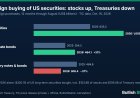
- 10-year rising with the 2-year stable: a term-premium or inflation story. Watch auctions, deficits and foreign demand (see TIC data on foreign buying).
- Real yields falling: usually a tailwind for gold and Bitcoin.
- Yields falling fast on bad news: can mean recession fears; crypto may fall first and benefit later.
Calendar: the numbers that move yields
| Release | Source | Next date |
|---|---|---|
| FOMC decision | Federal Reserve | October 28, 2026, 2 p.m. ET |
| CPI (October data) | BLS | November 10, 2026, 8:30 a.m. ET |
| Foreign holdings (TIC, September data) | US Treasury | November 18, 2026 |
| Daily yields | US Treasury | Every trading day |
Follow the details on our Fed rate decisions tracker and CPI tracker.
FAQ
Do rising bond yields always push Bitcoin down?
No. In 2026 the daily correlation was weak (−0.09). The effect is clearer on days with large yield jumps and during sustained hiking cycles such as 2022.
What is the difference between nominal and real yields?
The nominal yield is the stated return. The real yield, measured by TIPS, is the return after inflation. Real yields are the better gauge of the opportunity cost of holding Bitcoin or gold.
Why is the 10-year yield so high in 2026?
A combination of a Fed that raised rates in September 2026, inflation of 3.7% in September (CPI) and large US deficits that increase bond supply.
Where can I check Treasury yields?
The US Treasury publishes daily par yield curve rates on home.treasury.gov, and FRED (St. Louis Fed) keeps long historical series.
Guide: The US dollar and Bitcoin: how the dollar index moves crypto (2026 guide with data)
Latest: Bitcoin ETFs lose $635.6 million in one day, their worst since June (October 22, 2026)
Related reading: How Fed interest rates affect Bitcoin · Macroeconomics explained for crypto investors · Hammack and the 10-year above 5% · IMF: US deficit and debt · Foreign demand for Treasuries · Fed rate decisions tracker · CPI tracker · Bitcoin before the October FOMC
Sources: US Treasury, daily par yield curve rates · US Treasury, daily real yield curve rates · FRED, DGS10 · FRED, DFII10 · Coinbase Exchange, BTC-USD · Federal Reserve, FOMC calendar · BLS, CPI release schedule
This guide is for information only and is not investment advice. Crypto-assets are volatile and you can lose all the money you invest. Do your own research.
What's Your Reaction?
 Like
0
 Dislike
0
 Love
0
 Funny
0
 Wow
0
 Sad
0
 Angry
0















Comments (0)