

How Fed Interest Rates Affect Bitcoin and Crypto Markets
Why Fed rate hikes and cuts move Bitcoin: the five channels, what 2022 and 2024 taught investors, and what the 2026 hiking cycle means for crypto.

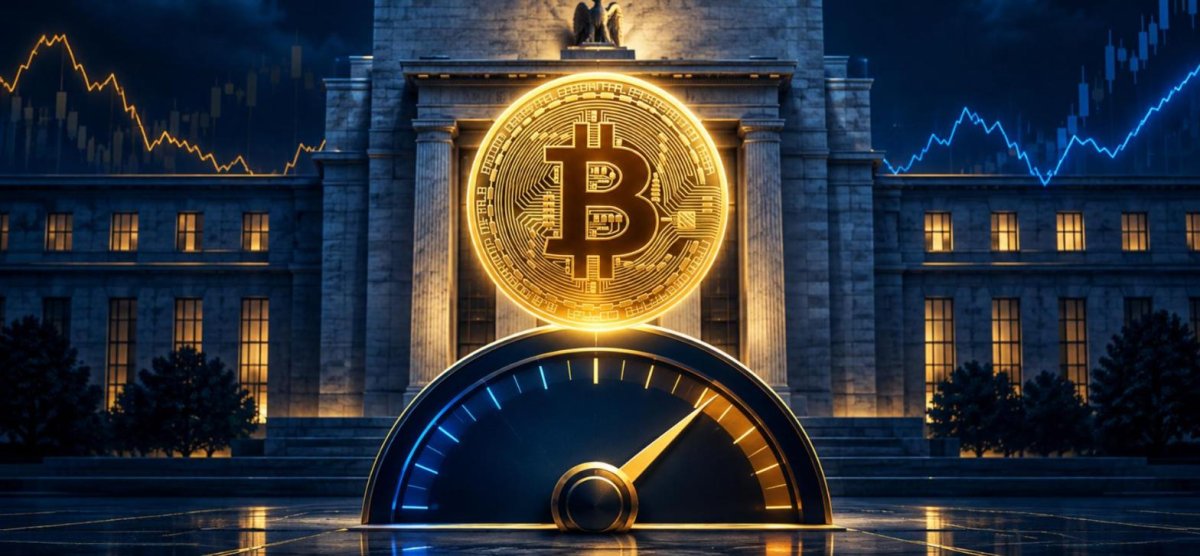
Key takeaways: Higher Federal Reserve interest rates usually weigh on Bitcoin because they raise the return on cash, strengthen the dollar, drain market liquidity and make leverage more expensive. Rate cuts tend to do the opposite. The effect works through expectations: markets often move before the FOMC decision, not after it.
Last updated: October 8, 2026
What does the Federal Reserve actually control?
The Federal Reserve sets a target range for the federal funds rate, the overnight rate at which US banks lend to each other. That decision is taken eight times a year by the Federal Open Market Committee (FOMC). The rate filters through to Treasury yields, mortgage rates, corporate borrowing costs and, ultimately, to how much investors are paid for holding cash instead of risk.
The Fed also controls the size of its balance sheet. Buying bonds (quantitative easing) adds liquidity to the system; letting bonds run off (quantitative tightening) removes it. For crypto, the two levers often matter as much as each other. For the wider picture, read why macroeconomics drives crypto markets.
The five channels between Fed policy and Bitcoin
| Channel | When rates rise | Why it matters for crypto |
|---|---|---|
| Opportunity cost | Cash and T-bills pay more | Bitcoin pays no yield, so holding it costs more in forgone interest |
| US dollar | The dollar tends to strengthen | Bitcoin is priced in dollars; a stronger dollar usually pressures dollar-priced risk assets |
| Liquidity | Money becomes scarcer and more expensive | Speculative assets lose marginal buyers first |
| Risk appetite | Investors rotate toward safety | Crypto trades as a high-beta risk asset in most stress periods |
| Leverage and funding | Borrowing and futures funding get dearer | Leveraged longs shrink, and forced liquidations can amplify drops |
None of these channels works mechanically. Bitcoin also responds to its own supply schedule, ETF flows, regulation and on-chain activity. But over the last five years, the Fed has been the single most important outside driver. See also how institutional money flows shape price.
What happened the last time the Fed hiked aggressively?
Between March 2022 and July 2023, the FOMC raised its target range from 0–0.25% to 5.25–5.50%, the fastest tightening cycle in four decades. Bitcoin, which had peaked near $69,000 in November 2021, fell to around $15,500 by November 2022. Crypto-specific failures (Terra/LUNA, Celsius, FTX) deepened the fall, but they unfolded in an environment where liquidity was being withdrawn.
The lesson for investors: rate hikes rarely break crypto on their own. They expose the weakest balance sheets, and the failures do the rest.
And when the Fed cuts?
In September 2024 the Fed cut by 50 basis points to 4.75–5.00%, the start of an easing cycle. Combined with demand from US spot Bitcoin ETFs (launched in January 2024), easier policy supported a rally that took Bitcoin to a record of roughly $126,000 on October 6, 2025. Cuts do not guarantee gains, but they remove one of the main headwinds. New to the asset? Start with our complete guide to Bitcoin.
Where are we in 2026?
The cycle has turned again. After holding at 3.50–3.75% for most of the year (see our July coverage: Bitcoin near $65K as the Fed weighed its July decision), the FOMC under Chair Kevin Warsh raised rates by 25 basis points on September 16, 2026, to 3.75–4.00%. It was the first hike since 2023. The median projection of FOMC participants points to about one more quarter-point increase before the end of 2026.
For crypto, that means the macro backdrop has shifted from "cuts are coming" to "higher for longer". Follow each decision in our Macro coverage and our latest Bitcoin and FOMC analysis.
Why markets move before the decision
Prices react to the gap between what the Fed does and what was expected. If futures markets already price a hike, the announcement itself can pass quietly. The bigger moves usually come from three moments:
- Inflation and jobs data that change the odds of the next move.
- The statement and press conference, which signal the path ahead.
- The dot plot (published in March, June, September and December), which shows where officials expect rates to go.
How investors use this in practice
- Track the FOMC calendar and the market-implied odds for each meeting.
- Watch the dollar index (DXY) and real yields alongside the Bitcoin price.
- Check funding rates and open interest before big macro events: crowded leverage is where liquidations start.
- Remember that large holders react to rates too, as when Strategy sold $216M of Bitcoin to fund dividends.
FAQ
Do higher interest rates always make Bitcoin fall?
No. Higher rates are a headwind, not a rule. Bitcoin can rise during a hiking cycle if ETF demand, supply dynamics or a crisis in the banking system push the other way.
Is Bitcoin a hedge against Fed policy?
In the short term, Bitcoin has mostly behaved like a risk asset that falls when liquidity tightens. Its "digital gold" case rests on its fixed 21 million supply over longer horizons.
Which matters more for crypto: rate levels or the Fed's balance sheet?
Both. Rates set the price of money; the balance sheet sets how much of it is in the system. Periods of quantitative easing have historically been the most supportive for crypto.
When is the next FOMC meeting?
The next meetings in 2026 are October 27–28 and December 8–9. The December meeting includes new economic projections.
How do stablecoins fit in?
Major stablecoin issuers hold much of their reserves in short-term Treasuries, so higher rates raise their income. Learn more in our guide What Is a Stablecoin?
This article is for information only and is not investment advice.
Related reading: Why Bitcoin is down today (October 2026)
Sources: Federal Reserve, FOMC calendars and statements · MUFG Research, September 2026 FOMC recap · MPA, 2026 FOMC dates
What's Your Reaction?
 Like
0
Like
0
 Dislike
0
Dislike
0
 Love
0
Love
0
 Funny
0
Funny
0
 Wow
0
Wow
0
 Sad
0
Sad
0
 Angry
0
Angry
0









Comments (0)