

CLARITY Act After the 49–50 Senate Vote: Shelved, Not Dead. What Comes Next?
The Senate blocked the CLARITY Act 49–50 on September 15, 2026. Why it failed, the pending motion to reconsider, and what the midterms mean for US crypto rules.


Three weeks after the US Senate refused to open debate on the CLARITY Act, the crypto market-structure bill is stalled but technically alive. A pending motion to reconsider keeps it on the table. In practice, US crypto rules will be shaped by the SEC and the CFTC until Congress returns to the issue, most likely in 2027.
What happened on September 15
The Senate voted 49 to 50 on cloture, the procedural step needed to start debating the Digital Asset Market Clarity Act. The bill needed 60 votes and fell 11 short. No Democrat voted yes. Republicans Susan Collins, Josh Hawley and Jerry Moran voted no. Thom Tillis, who supports the bill, switched his vote to no so that he could file a motion to reconsider, a standard Senate tactic that lets the majority bring the bill back later.
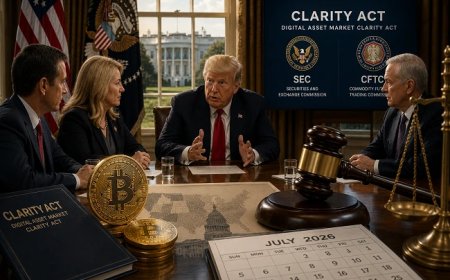
The vote came after Majority Leader John Thune filed cloture on August 8 to force a September decision. BullishStation covered the earlier White House talks in July: CLARITY Act: Trump Meets Senators at White House.
Why it failed
The core design of the bill, splitting oversight between the SEC and the CFTC, was not the main dispute. The bill stalled on three issues:
| Sticking point | What was at stake |
|---|---|
| Ethics provisions | Democrats wanted strict limits on crypto income for senior officials, including the president. Two revised drafts did not satisfy them. |
| DeFi developer liability (Section 604) | How far registration duties reach into decentralized protocols. |
| Stablecoin yield (Section 404) | Whether exchanges can offer rewards on stablecoins that resemble bank deposits; banks pushed for limits, exchanges against. Background: What Is a Stablecoin? |
The political calendar also weighed: the vote came seven weeks before the November 3 midterm elections.
How markets reacted
Bitcoin slipped to around $76,000 on the day of the vote, and Coinbase shares fell more than 8%. The reaction was modest because prediction markets had already priced a low chance of passage; odds had dropped to about 16% in early September. Bitcoin has since recovered to the low $80,000s: see our latest Bitcoin market update.
What happens next
- Motion to reconsider: the majority leader can bring the bill back if an ethics deal emerges. No agreement has been announced.
- Lame-duck session (November–December 2026): possible in theory, but the House calendar and the ethics dispute make it unlikely.
- 2027 restart: the midterms will decide who chairs the Senate Banking Committee. A change of majority could produce a very different bill. Senator Cynthia Lummis, the bill's lead Republican negotiator, is not running for reelection.
- Agencies fill the gap: the SEC's proposed "Regulation Crypto Assets" is open for comment until October 20. Read our breakdown: SEC Regulation Crypto Assets: comments close October 20.
Why it matters for investors
Without a statute, the rules come from agencies. Agency rules are faster to write but easier for a future administration to reverse. Products that depend on clear legal classification, such as tokenized securities and some spot-market structures, may be delayed into 2027 or 2028. Bitcoin and Ether, whose status is the least disputed, are the least affected. For the macro side of the picture, see How Fed Interest Rates Affect Bitcoin, and for how politics moves crypto more broadly, how global power dynamics shape digital asset markets.
Related reading: CFTC crypto rules: the new crypto asset market framework
Sources: BIT Knowledge Hub, CLARITY Act vote analysis · Cointelegraph · Bitcoin.com News · Congress.gov, H.R. 3633
What's Your Reaction?
 Like
0
Like
0
 Dislike
0
Dislike
0
 Love
0
Love
0
 Funny
0
Funny
0
 Wow
0
Wow
0
 Sad
0
Sad
0
 Angry
0
Angry
0












Comments (0)