

Hormuz Oil Traffic Hits Low as UKMTO Threat Level Peaks
anker traffic through the Strait of Hormuz falls to a two-month low as UKMTO raises its threat level to "severe" and the Islamabad Memorandum collapses. Facts, timeline, and market impact.

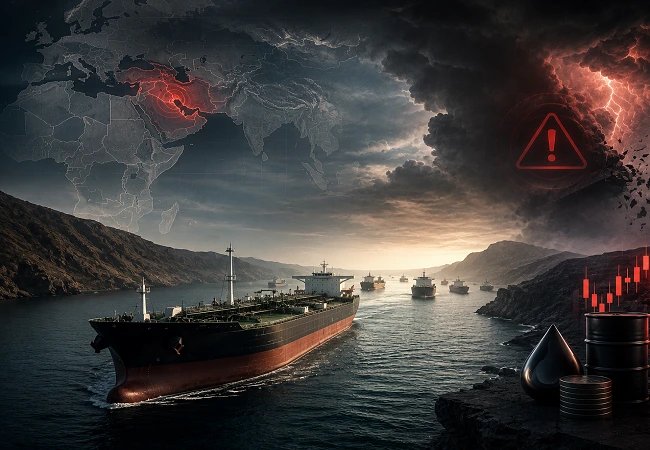
Tanker traffic through the Strait of Hormuz fell to its lowest level in two months on Monday, after a fresh escalation between the United States and Iran.
For how energy shocks travel into crypto, see how geopolitics shapes digital asset markets.
Key takeaways
- Tanker traffic through the Strait of Hormuz dropped to its lowest level since late May, shipping-tracking data shows.
- US forces carried out a third round of strikes on 11 July, hitting roughly 140 Iranian military targets.
- Iran declared the strait closed after an attack on a Cyprus-flagged container ship; Washington disputes the closure.
- Iran's new Supreme Leader, Mojtaba Khamenei, vowed to avenge his father's assassination.
- Oil prices jumped, reviving concerns over global energy supply.
The Strait of Hormuz carries about 21% of the world's crude oil and roughly a quarter of globally traded liquefied natural gas [to be confirmed against the latest IEA/EIA figures]. Prolonged disruption there directly affects energy prices, industrial supply chains, and — further down the line — the price of nitrogen fertilisers critical to global food security.
Shipping-tracking data showed the number of vessels transiting the strait fell to its lowest level since 25 May. Many ships are now switching off their AIS transponders to reduce risk, making an exact count difficult.
On 11 July, US Central Command (CENTCOM) said it had completed a third round of strikes that week, hitting roughly 140 Iranian military targets — missile and drone sites, naval capabilities, ammunition storage facilities and coastal surveillance locations. The strikes followed an attack, attributed to Iran's Islamic Revolutionary Guard Corps, on a Cyprus-flagged container ship, which caused a fire and significant engine-room damage; one crew member remains missing.
In response, Iran declared the strait closed "until further notice," citing alleged foreign interference. Washington disputes the closure, saying the waterway remains open and under military protection.
Iran's new Supreme Leader, Mojtaba Khamenei — son of former Supreme Leader Ali Khamenei, who was killed in the initial 28 February strikes — issued a statement vowing to avenge his father's death, describing it as "the demand of the nation."
Mediation efforts are ongoing, notably through Oman and Pakistan, around the Islamabad Memorandum, signed 17 June in Versailles by Donald Trump and in Tehran by Iranian President Masoud Pezeshkian. Both sides now consider it defunct: Washington revoked the licence allowing Iranian crude sales on 8 July, Trump declared the deal "over," and Tehran accuses the US of violating "almost every component" of the ceasefire.
- UKMTO's threat level for the strait is set at "severe", the highest tier, maintained for several days despite a partial reopening of the southern corridor near Omani waters.
- The vessel struck is the Cyprus-flagged container ship GFS Galaxy: one crew member remains missing, and the fire caused engine-room damage.
- Traffic through the strait fell to just six vessels between 18:00 GMT Thursday and 06:00 GMT Friday, down from 18-22 daily crossings earlier in July (Windward data).
Table — Timeline
| Date | Event |
|---|---|
| 28 February 2026 | Initial US-Israeli strikes; death of Supreme Leader Ali Khamenei |
| June 2026 | Memorandum signed aiming to end hostilities |
| 6-8 July 2026 | Attacks on several commercial vessels in the strait |
| 11 July 2026 | Third round of US strikes (~140 targets); Iran declares strait closed |
| 13 July 2026 | Tanker traffic at two-month low; tensions persist |
Market impact
Reactions vary sharply across asset classes. In oil markets, Brent is up roughly 4% on Monday to around $79 a barrel (WTI similarly near $74), driven by the drop in strait traffic. Analysts note the rise remains measured relative to the severity of the escalation, suggesting markets read this as renewed fighting within a fragile truce rather than a full ceasefire collapse though a prolonged standoff over the strait's status could shift that reading quickly.
In equity markets, the reaction is markedly sharper in Asia than in Europe. Seoul's Kospi fell more than 5%, hit by both risk-off sentiment and profit-taking in semiconductor stocks; Tokyo also declined. European indices (CAC 40, DAX, FTSE 100) are trading close to flat, suggesting a degree of desensitisation among Western investors to a conflict now in its fifth month. US futures pointed to a lower Wall Street open, particularly in tech and semiconductor names.
Among safe-haven assets, the dollar strengthened slightly against a basket of currencies on renewed risk aversion and inflation concerns that could affect central bank rate paths. Gold, by contrast, edged lower despite the geopolitical tension a partial decoupling some strategists read as market fatigue with a chronic conflict rather than any real easing of risk.
Finally, the broader at-risk markets currencies and equities of economies most dependent on energy and fertiliser imports via Hormuz (South Asia, parts of Africa) remain the most exposed to a prolonged crisis, particularly through pressure on LNG and nitrogen fertiliser prices, two markets with no meaningful bypass route around the strait.
Related reading: How geopolitics shapes digital asset markets · How macroeconomics drives crypto markets · China's AI bubble and hedge fund caution · Bitcoin ahead of the October 2026 FOMC · Geopolitics and crypto · US to seize $1 billion in Iranian crypto
Further reading (official sources): UKMTO maritime security advisories · U.S. EIA: world oil transit chokepoints
What's Your Reaction?
 Like
0
Like
0
 Dislike
0
Dislike
0
 Love
0
Love
0
 Funny
0
Funny
0
 Wow
0
Wow
0
 Sad
0
Sad
0
 Angry
0
Angry
0

Comments (0)