

How Artificial Intelligence Is Converging With Crypto
Artificial intelligence and blockchain are converging to create a new generation of financial infrastructure. Learn how AI agents, on-chain data analysis, and decentralized compute are reshaping the crypto landscape.

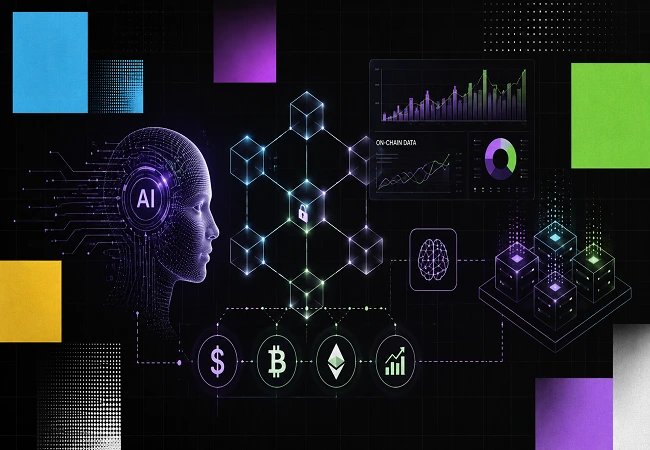
For most of crypto's history, artificial intelligence and blockchain were parallel universes. AI researchers built neural networks in the cloud. Crypto developers built decentralized protocols on public chains. The two communities barely overlappeThat is no longer true.
In 2025 and 2026, the convergence of AI and blockchain has become one of the most consequential structural shifts in both industries. AI is transforming how crypto markets are analyzed, how trading strategies are executed, and how blockchain infrastructure is governed. Simultaneously, blockchain is emerging as essential infrastructure for the AI economy providing computation markets, data provenance, and autonomous economic agents with the ability to transact value.
This is not hype. The institutional capital flowing into AI-blockchain intersection projects, the product launches from major players, and the genuine use cases now in production make this one of the most important themes for investors and technologists to understand.
Why AI and Blockchain Are Converging
The convergence is driven by genuine complementarity. Each technology solves problems that the other cannot.
AI needs from blockchain:
- Decentralized, censorship-resistant compute resources (not dependent on AWS or Google Cloud)
- Verifiable provenance for training data
- Transparent, auditable model governance
- Economic infrastructure for autonomous AI agents
Blockchain needs from AI:
- Better tools for on-chain data analysis and anomaly detection
- AI-powered smart contract auditing
- Intelligent routing and optimization for DeFi protocols
- Natural language interfaces that make Web3 accessible to non-technical users
The result is not one technology absorbing the other, but a symbiotic relationship where each enhances the capabilities of the other.
AI Agents: The New Participants in Crypto Markets
The most immediately impactful development is the emergence of AI agents autonomous software programs that can perceive their environment, make decisions, and take actions to achieve defined goals operating within crypto ecosystems.
What AI Agents Can Do On-Chain
Unlike traditional bots (which execute predefined rules), modern AI agents powered by large language models (LLMs) can:
- Interpret complex, unstructured information (news, social media, on-chain events) and execute trades
- Manage DeFi positions autonomously optimizing yields across protocols, rebalancing collateral, and responding to market events
- Execute multi-step, multi-protocol strategies that would require hours of human coordination
- Operate continuously without sleep, breaks, or emotional bias
For these agents to operate on-chain, they need wallets crypto addresses that can hold assets and execute transactions. This is the foundational link between AI and blockchain: AI agents are becoming native economic actors in the crypto ecosystem.
AI Agents in DeFi
Several DeFi protocols have been specifically designed to support AI agent interaction. "Agent-friendly" protocols expose clean APIs, predictable smart contract interfaces, and gas-optimized execution paths. Early AI agent funds DeFi strategies managed entirely by AI systems have demonstrated competitive performance versus human-managed approaches in specific market conditions.
The risk, of course, is that AI agents introduce new systemic risks: coordinated behavior by multiple agents using similar models could amplify market volatility, and AI-managed positions can fail in unexpected ways when market conditions fall outside the agent's training distribution.
AI-Powered On-Chain Analysis
One of the most mature applications of AI in crypto is on-chain data analysis. The Bitcoin and Ethereum blockchains generate millions of transactions per day, creating a data set of enormous complexity. AI systems are uniquely well-suited to extract signal from this noise.
Pattern Recognition at Scale
AI models trained on historical on-chain data can identify patterns associated with:
- Market tops and bottoms (analyzing the behavior of long-term holders)
- Exchange deposit clustering (detecting potential sell pressure before it hits)
- Anomalous wallet behavior consistent with pre-trade insider positioning
- Protocol exploit precursors (unusual liquidity movements before known hacks)
Blockchain Analytics for Compliance
Firms like Chainalysis, Elliptic, and TRM Labs use machine learning to trace the movement of funds across blockchain networks, even through mixing services and cross-chain bridges. Their models power Know Your Transaction (KYT) compliance at exchanges worldwide and support law enforcement investigations.
The sophistication of these tools has grown dramatically, making the blockchain paradoxically more transparent than many traditional financial systems in its ability to trace historical flows.
Decentralized AI Compute: The Infrastructure Layer
Running large AI models requires enormous computing resources. Currently, this is dominated by a handful of centralized cloud providers: Amazon Web Services, Google Cloud, and Microsoft Azure. This concentration creates risks: censorship, pricing power, and single points of failure.
Decentralized Compute Protocols
A new category of blockchain protocol is emerging to address this: decentralized compute networks that aggregate underutilized GPU capacity from data centers and individual operators, making it available to AI developers on a permissionless basis.
Projects in this space are creating markets for GPU compute that are:
- More censorship-resistant than centralized cloud
- Potentially cheaper due to competition and utilization of idle capacity
- Composable with DeFi and other blockchain applications
The addressable market is enormous: the global cloud computing market was valued at over $700 billion in 2026, with AI compute representing its fastest-growing segment.
Data Provenance and Model Verification
A second critical infrastructure layer is data provenance the ability to verify where AI training data came from and whether it has been tampered with.
Blockchain-based provenance systems can create immutable records of data origin, licensing, and usage. This is valuable for:
- Ensuring AI models were not trained on copyrighted or manipulated data
- Creating auditable records for regulatory compliance
- Enabling fair compensation for data creators whose work trains AI models
AI for Crypto Market Analysis
At BullishStation, the intersection of AI and market analysis is of direct relevance to our readers. AI tools are transforming how investors and analysts approach crypto markets.
Natural Language Processing for Sentiment Analysis
LLMs can process thousands of news articles, social media posts, forum discussions, and on-chain events in real time, synthesizing sentiment signals that would be impossible to track manually. Advanced systems now correlate sentiment signals with price movements, funding rates, and on-chain flows to generate probabilistic market outlooks.
Predictive Analytics
AI models trained on historical crypto market data can identify patterns in: volatility clustering, funding rate cycles, whale accumulation behavior, and the market's response to specific macro events (CPI releases, FOMC decisions, geopolitical shocks). These are not crystal ball predictions, but they provide a systematic framework for probabilistic risk management.
AI-Assisted Smart Contract Auditing
Smart contract vulnerabilities have cost the DeFi ecosystem billions of dollars in hacks. AI models trained on historical vulnerability data can now identify many classes of vulnerabilities automatically not replacing human auditors, but dramatically accelerating the audit process and catching errors that manual review might miss.
AI Regulation: The Coming Governance Battle
The intersection of AI and crypto creates a particularly complex regulatory environment.
Financial Regulation of AI Trading
Regulators worldwide are developing frameworks for AI-driven trading systems. Key questions:
- Who is liable when an AI agent causes market manipulation the operator, the developer, or the protocol?
- How should AI-managed DeFi funds be classified and regulated?
- What disclosure requirements should apply to AI-powered trading strategies?
AI and Crypto Combined Oversight
In 2025–2026, multiple jurisdictions began exploring combined regulatory frameworks that address AI and crypto simultaneously recognizing that AI-powered trading bots, AI-managed DeFi strategies, and AI-driven market manipulation require specific regulatory tools that existing frameworks do not provide.
The EU's AI Act (2024) and the ongoing development of MiCA (Markets in Crypto-Assets) regulation have begun to intersect in ways that will define the compliance landscape for AI-native crypto applications over the next five years.
Key Projects and Sectors to Watch
| Category | What to Watch |
|---|---|
| Decentralized compute | GPU compute marketplaces, inference infrastructure |
| AI agents in DeFi | Autonomous yield strategies, on-chain agent wallets |
| On-chain analytics AI | Predictive models integrated with live blockchain data |
| Data provenance | Blockchain-verified training data markets |
| AI-native protocols | New protocol designs built specifically for AI agent interaction |
| Regulatory frameworks | EU AI Act × MiCA overlap, US AI trading regulations |
Conclusion
The convergence of AI and blockchain is early, significant, and accelerating. It is not a narrative it is an infrastructure buildout with genuine economic logic. AI agents need blockchain for autonomous economic operation. Blockchain ecosystems need AI for analysis, security, and accessibility.
For investors and analysts, the key is to separate projects with genuine technical differentiation and real use cases from the numerous AI-branded projects that add the label without the substance.
BullishStation's AI section tracks this convergence rigorously covering AI agents in DeFi, AI-powered market analysis, decentralized compute infrastructure, and the regulatory environment shaping the future of intelligent, decentralized finance.
Related reading: How AI is changing crypto security audits · China's AI bubble and hedge fund caution · Robinhood Chain and tokenized stocks on Arbitrum · What is Web3? DeFi, blockchain and tokenization explained · AI and crypto coverage · AI agents in crypto: wallets and x402 payments · AI regulation and crypto: EU AI Act and US rules
Further reading (official sources): NIST AI Risk Management Framework · European Commission: AI regulatory framework
What's Your Reaction?
 Like
0
Like
0
 Dislike
0
Dislike
0
 Love
0
Love
0
 Funny
0
Funny
0
 Wow
0
Wow
0
 Sad
0
Sad
0
 Angry
0
Angry
0


Comments (0)