

Ethereum and the Layer 1/Layer 2 Ecosystem
Ethereum is the programmable blockchain at the heart of DeFi, Web3, and tokenization. This guide explains how Ethereum works, what Layer 2s are, and why the L1/L2 ecosystem matters for digital asset investors.

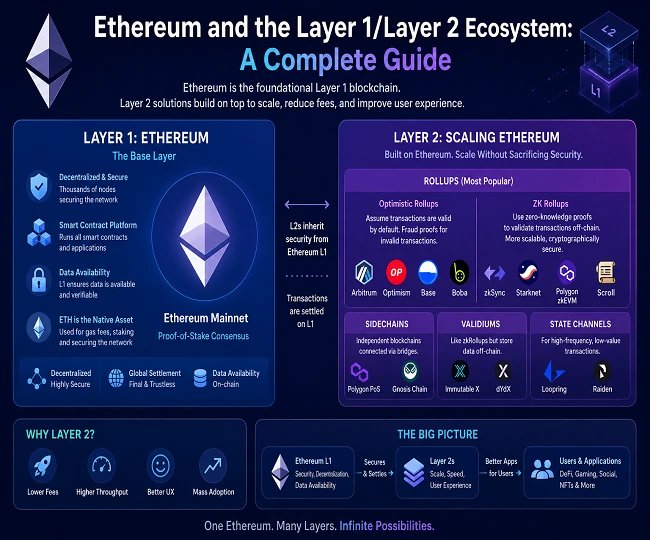
If Bitcoin is digital gold a store of value and settlement network then Ethereum is the digital economy's operating system.
Where Bitcoin does one thing (transfer and store value) with unmatched security and simplicity, Ethereum was designed to be programmable: a blockchain that can run arbitrary code, creating what its founder Vitalik Buterin called a "world computer." From this programmability emerged decentralized finance, NFTs, stablecoins, DAOs, and the broader Web3 ecosystem.
Ethereum is the second-largest digital asset by market capitalization and the most widely used smart contract platform in the world. Understanding it along with the Layer 1/Layer 2 ecosystem that has grown around it is essential for anyone working in digital assets beyond Bitcoin.
What Is Ethereum?
Ethereum is a public blockchain launched in July 2015. Like Bitcoin, it is decentralized maintained by a global network of nodes with no central authority. Unlike Bitcoin, it supports smart contracts: programs stored on the blockchain that execute automatically when predefined conditions are met.
Think of a smart contract as a vending machine. You insert a coin (deposit ETH), you select a product (call a function), the machine executes the logic and dispenses the result without a human cashier, without trust in the operator, without the ability for either party to renege.
This simple concept trustless, automated execution of code on a decentralized network is the foundation of the entire DeFi, NFT, and Web3 ecosystem.
Ether (ETH): The Native Fuel
Ether (ETH) is the native cryptocurrency of the Ethereum network. It serves two distinct functions:
- Payment for computation: Every operation on the Ethereum network requires a fee paid in ETH (called "gas"). This prevents spam and compensates validators.
- Store of value: ETH is held by investors as an asset that accrues value as network usage grows.
The "gas" fee mechanism means ETH has what analysts call a utility floor: as long as the Ethereum network is used for smart contract execution, there is intrinsic demand for ETH to pay for that computation. This is fundamentally different from Bitcoin's value proposition (scarcity and monetary policy) and gives ETH a distinct investment thesis.
The Merge: Ethereum's Transition to Proof of Stake
In September 2022, Ethereum underwent its most significant upgrade — "The Merge" — transitioning its consensus mechanism from Proof of Work to Proof of Stake.
What Changed
Under Proof of Work (like Bitcoin), validators compete through computational work (mining) to add blocks. Under Proof of Stake, validators lock up (stake) ETH as collateral. They are selected to propose blocks proportionally to their stake, and they earn rewards for honest participation. Dishonest behavior results in their stake being "slashed" (destroyed).
The Merge achieved several objectives:
- Reduced Ethereum's energy consumption by approximately 99.95%
- Eliminated Bitcoin-style mining from Ethereum's security model
- Made ETH stakers the new stakeholders in network security
ETH as a Yield-Bearing Asset
Post-Merge, ETH can be staked to earn yield (currently 3–5% annually). This transformed ETH's investment profile: it is now a productive asset that generates income, not merely a speculative holding. Liquid staking protocols (Lido, Rocket Pool) allow holders to earn staking rewards while keeping their ETH liquid and usable in DeFi.
Smart Contracts: The Engine of the Ethereum Economy
Smart contracts are deployed to the Ethereum blockchain as bytecode and assigned a unique address. Once deployed, they are immutable (unless the developer included an upgrade mechanism) and execute deterministically for everyone who interacts with them.
What Smart Contracts Enable
The composability of smart contracts the ability for contracts to call other contracts creates a kind of financial Lego. Developers can build complex applications by combining primitive smart contracts like:
- ERC-20 tokens: The standard for fungible tokens (used for stablecoins, governance tokens, DeFi protocol tokens)
- ERC-721/1155: The standards for NFTs (non-fungible tokens representing unique digital assets)
- Liquidity pools: Contracts that hold asset pairs for decentralized exchange
- Lending markets: Contracts that match borrowers and lenders algorithmically
The result is a self-contained financial ecosystem where, as of 2026, hundreds of billions of dollars in value are held and traded through smart contract code.
The Scalability Problem and the Layer 2 Solution
Ethereum's success created a fundamental problem: the base layer cannot process enough transactions to support mass adoption without prohibitive fees.
Ethereum's main chain processes approximately 15–30 transactions per second (TPS). Visa processes tens of thousands. During periods of high demand, Ethereum gas fees have spiked to hundreds of dollars per transaction, making small-value DeFi interactions economically unviable.
The Blockchain Trilemma
Blockchain systems face a fundamental trade-off known as the trilemma: you can optimize for decentralization, security, or scalability but not all three simultaneously.
Ethereum prioritized decentralization and security. Scalability is being addressed through Layer 2 solutions.
What Is a Layer 2?
A Layer 2 (L2) is a separate blockchain that processes transactions off the Ethereum main chain but periodically settles to it. The key insight is that not every transaction needs to be processed and stored by every node in the decentralized network only final settlements do.
L2s inherit Ethereum's security (because they settle to it) while dramatically increasing throughput and reducing fees.
Rollup Technology
The dominant L2 architecture is the rollup. Rollups batch hundreds or thousands of transactions together, process them off-chain, and submit a compressed summary to Ethereum. Two main types:
- Optimistic Rollups (Arbitrum, Optimism, Base): Assume transactions are valid by default. A challenge period allows anyone to submit a fraud proof if a transaction is incorrect. Simpler and more EVM-compatible.
- ZK Rollups (zkSync, Polygon zkEVM, StarkNet): Generate a cryptographic proof (zero-knowledge proof) that all transactions in the batch are valid. No challenge period needed. More mathematically complex but faster finality.
The L1 Landscape Beyond Ethereum
While Ethereum is the dominant smart contract platform, several alternative Layer 1 blockchains compete for developer activity and user adoption:
Solana (SOL)
Solana is designed for high throughput — processing thousands of transactions per second at fractions of a cent. It achieves this through a consensus mechanism (Proof of History) that trades some decentralization for speed. Solana is the dominant platform for high-frequency DeFi, memecoins, and consumer applications that require fast, cheap transactions.
Avalanche (AVAX)
Avalanche uses a novel consensus protocol that achieves fast finality with high decentralization. Its "subnet" architecture allows developers to create customized blockchain environments within the Avalanche ecosystem, making it attractive for institutional and enterprise blockchain deployments.
BNB Chain (BNB)
Binance Smart Chain (now BNB Chain) is a more centralized alternative to Ethereum, maintained primarily by Binance's infrastructure. Its low fees and Ethereum compatibility drove significant DeFi activity, particularly in emerging markets. However, its centralization has been a persistent criticism.
The Multi-Chain Future
The current consensus among developers and researchers is that the future is multi-chain: different applications will run on different chains and L2s optimized for their specific requirements, connected through cross-chain bridges and interoperability protocols.
Ethereum for Investors: Key Metrics to Track
For investors analyzing ETH and the L1/L2 ecosystem, the key on-chain and market metrics include:
| Metric | What It Measures | Source |
|---|---|---|
| Total Value Locked (TVL) | Economic activity secured by smart contracts | DeFiLlama |
| Daily Active Addresses | Network usage and adoption trends | Glassnode, Etherscan |
| Gas fees (gwei) | Demand pressure on block space | Etherscan |
| ETH staking rate | % of supply staked; yield impact | Beaconcha.in |
| L2 TVL vs L1 TVL | Migration of activity to Layer 2 | L2Beat |
| Issuance / burn rate | Net ETH supply change (EIP-1559) | Ultrasound.money |
| Revenue (fees) | Value generated by network | Token Terminal |
EIP-1559 and ETH's Deflationary Mechanics
Since the EIP-1559 upgrade in 2021, a portion of every Ethereum transaction fee is burned (destroyed), rather than paid to validators. In periods of high network activity, ETH issuance can be exceeded by burning, making ETH net deflationary. This "ultrasound money" property has become an important part of ETH's investment thesis.
Ethereum vs. Bitcoin: Different Assets, Different Theses
A common source of confusion is treating ETH and BTC as competing assets. They are better understood as complementary, with distinct investment theses:
| Property | Bitcoin (BTC) | Ethereum (ETH) |
|---|---|---|
| Primary thesis | Store of value / digital gold | Productive asset / smart contract platform |
| Supply | Hard capped at 21 million | Variable (EIP-1559 burn mechanism) |
| Yield | None | 3–5% staking yield |
| Regulatory classification | Commodity (clearest) | Mixed / evolving |
| Correlation with macro | High (risk asset) | High (risk asset) |
| Institutional adoption | Highest | Growing (ETF, staking) |
Conclusion
Ethereum and the Layer 1/Layer 2 ecosystem represent the programmable layer of the digital asset economy. While Bitcoin provides the monetary foundation, Ethereum and its ecosystem provide the infrastructure for decentralized finance, tokenization, and the broader Web3 vision.
For investors and analysts, the L1/L2 landscape is one of the most technically complex and rapidly evolving areas of digital assets. The key questions which chains will capture the most economic activity, whether Ethereum's L2-centric roadmap will succeed, and how the multi-chain future will consolidate will be among the most consequential narratives in crypto over the next several years.
BullishStation's Digital Assets section tracks Ethereum, Layer 2 developments, and the competitive L1 landscape with in-depth analysis, on-chain data, and institutional perspective.
Related reading: Ethereum's Lean roadmap and what it means for markets · Robinhood Chain and tokenized stocks on Arbitrum · What is Web3? DeFi, blockchain and tokenization explained · What is Bitcoin? Our complete guide · Digital assets coverage · How AI is converging with crypto
Further reading (official sources): ethereum.org: Ethereum roadmap · L2BEAT: Layer 2 data
What's Your Reaction?
 Like
0
Like
0
 Dislike
0
Dislike
0
 Love
0
Love
0
 Funny
0
Funny
0
 Wow
0
Wow
0
 Sad
0
Sad
0
 Angry
0
Angry
0

Comments (0)