

What Is Bitcoin? A Complete Guide for Investors
Bitcoin explained for investors: how the first digital asset works, its fixed 21 million supply, halvings, ETFs and institutional adoption, and the risks to understand in 2026.

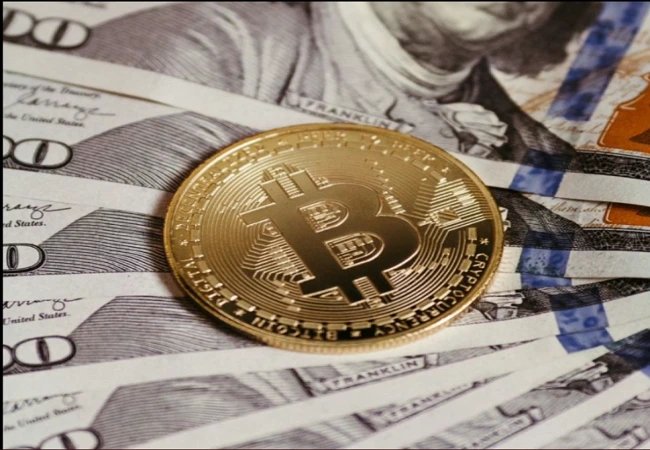
Key takeaways: Bitcoin (BTC) is a decentralized digital currency with a fixed maximum supply of 21 million coins. It runs on a public blockchain secured by proof-of-work mining, has no issuer or central authority, and has grown from a 2009 experiment into an asset class held by ETFs, listed companies and governments. It remains highly volatile and is best understood as a scarce, global, programmable store of value.
Last updated: October 8, 2026
What is Bitcoin, exactly?
Bitcoin is a digital currency that runs on a peer-to-peer network. It has no central issuer, no CEO and no headquarters. A global network of computers, called nodes, keeps a shared, public ledger called the blockchain.
Every Bitcoin transaction is recorded permanently on that ledger. Once confirmed, an entry cannot be altered or deleted. This immutability is what separates Bitcoin from ordinary digital money, which is simply a balance in a bank's database.
Bitcoin was created by a person or group using the pseudonym Satoshi Nakamoto, who published the white paper "Bitcoin: A Peer-to-Peer Electronic Cash System" in October 2008, during the global financial crisis. Nakamoto mined the first block, the genesis block, on January 3, 2009, and embedded in it a newspaper headline about a second bank bailout in the United Kingdom. The message signaled Bitcoin's purpose: an alternative to a financial system that had just shown its fragility.
How does Bitcoin work?
The blockchain
The Bitcoin blockchain is a growing chain of blocks. Each block contains:
- a list of validated transactions;
- a timestamp;
- a cryptographic reference (hash) to the previous block;
- the solution to a computational puzzle (proof of work).
Because each block points to the one before it, changing any historical block would require redoing all the computing work done since. On a network this large, that is not realistic for any attacker.
Mining and proof of work
New transactions are confirmed through mining. Miners compete to solve a mathematical puzzle; the first to succeed adds the next block and receives newly created bitcoin, the block reward, plus transaction fees.
This process, called proof of work (PoW), does two things:
- It secures the network by making attacks extremely expensive.
- It issues new bitcoin on a predictable, transparent schedule.
The network adjusts the puzzle's difficulty every 2,016 blocks (about every two weeks) so that a new block is found roughly every 10 minutes, whatever the total computing power.
Wallets and keys
Ownership of bitcoin is managed with cryptographic key pairs:
- Private key: a secret 256-bit number that proves ownership and authorizes spending. It must never be shared.
- Public key and address: derived from the private key, the address is what you share to receive bitcoin, similar to an account number.
Sending bitcoin means signing a message with your private key. Anyone on the network can verify that signature without ever seeing the key itself.
Bitcoin's monetary properties
What makes Bitcoin unusual as a financial asset is not only its technology but its monetary design.
A fixed supply of 21 million BTC
Bitcoin's maximum supply is hard-coded at 21 million coins. Changing it would require the agreement of an overwhelming majority of the network, which in practice has proven impossible. By contrast, the supply of major fiat currencies has expanded many times over since 2008.
The halving
Roughly every four years (every 210,000 blocks), the block reward is cut in half. Halvings took place in 2012, 2016, 2020 and April 2024, when the reward fell to 3.125 BTC per block. The next is expected around 2028. Each halving reduces the flow of new supply; past halvings have preceded strong bull markets, though past patterns are no guarantee. Read more in our guide to how macroeconomics drives crypto markets.
Divisibility and portability
One bitcoin divides into 100 million units called satoshis ("sats"). It can be sent anywhere in the world in minutes, for any amount, at any hour.
Bitcoin as a store of value
The dominant narrative today is digital gold: an asset that preserves purchasing power over long periods. Like gold, Bitcoin is scarce, durable, portable, divisible and fungible. Unlike gold, it moves over digital networks, its total supply can be audited by anyone at any time, and its scarcity is set by code rather than geology.
| Property | Bitcoin | Gold |
|---|---|---|
| Supply | Fixed at 21M, fully auditable | Estimated, grows ~1–2% a year |
| Portability | Global transfer in minutes | Physical transport, costly |
| Divisibility | 100 million sats per coin | Limited in practice |
| Track record | Since 2009 | Thousands of years |
| Volatility | High | Low to moderate |
Institutional adoption
Bitcoin's integration into mainstream finance accelerated after 2020:
- January 2024: the US SEC approved the first spot Bitcoin ETFs. BlackRock's iShares Bitcoin Trust (IBIT) became the fastest ETF in history to reach $10 billion in assets.
- 2024–2026: listed companies built large Bitcoin treasuries; Strategy (formerly MicroStrategy) became the largest corporate holder, with hundreds of thousands of BTC. See Strategy's first Bitcoin sale.
- March 2025: a US executive order created the Strategic Bitcoin Reserve, made up of bitcoin the government had seized, with a commitment not to sell it.
Institutional capital has made Bitcoin more liquid, but also more sensitive to interest rates, the US dollar and regulation. See how Fed interest rates affect Bitcoin and how institutional money flows shape crypto prices.
Bitcoin vs. other digital assets
| Property | Bitcoin (BTC) | Ethereum (ETH) | Most altcoins |
|---|---|---|---|
| Supply | Hard cap: 21M | No hard cap; issuance managed by protocol | Varies widely |
| Consensus | Proof of Work | Proof of Stake | Varies |
| Main use | Store of value, settlement | Smart-contract platform | Applications |
| Institutional adoption | Highest | Growing | Limited |
| US regulatory status | Treated as a commodity | Largely treated as a commodity | Often uncertain |
Bitcoin does one thing, transferring and storing value without a central authority, and does it with a security record no other network matches. For the programmable side of crypto, read Ethereum and the Layer 1 / Layer 2 ecosystem. For dollar-pegged tokens, read What is a stablecoin?
Risks to understand
- Volatility: drawdowns of 30% to more than 80% have happened several times. Bitcoin peaked near $126,000 in October 2025 and traded around $83,000 in early October 2026 (see Bitcoin ahead of the October 2026 FOMC).
- Regulatory risk: bans, tax rules, ETF decisions or competition from central bank digital currencies can move the price. Follow the SEC crypto asset rulemaking and the CLARITY Act.
- Custody risk: the protocol has never been hacked, but exchange failures (Mt. Gox in 2014, FTX in 2022) cost investors billions.
- Energy use: mining consumes significant electricity, a recurring regulatory and reputational issue.
- Concentration: a large share of supply sits in a small number of wallets, whose moves can affect the market.
How investors approach Bitcoin
- Custody: self-custody with a hardware wallet, an exchange account, or an institutional custodian (Coinbase Custody, BitGo, Fidelity Digital Assets).
- Position sizing: many institutional allocations range from 1% to 5% of a portfolio, reflecting Bitcoin's volatility.
- Vehicles: direct purchase, spot ETFs (available in the US, the EU and several other jurisdictions), futures or other derivatives.
- Tax: in most jurisdictions Bitcoin is treated as property, so capital gains tax applies on disposal. Seek local professional advice.
FAQ
Who created Bitcoin?
An anonymous person or group called Satoshi Nakamoto, who published the white paper in 2008 and launched the network in January 2009.
How many bitcoins are there?
The supply is capped at 21 million. The last fraction is expected to be mined around 2140.
What is a Bitcoin halving?
An event every 210,000 blocks that cuts the mining reward in half. The most recent was in April 2024.
Is Bitcoin legal?
It is legal to hold and trade in most major economies, including the US and the EU, though rules differ by country.
Can Bitcoin be hacked?
The Bitcoin protocol has never been successfully attacked. Losses have come from hacked or failed exchanges and from users losing their private keys.
Conclusion
Bitcoin is the oldest, simplest and most battle-tested digital asset. Its fixed supply, 17-year track record and growing place in institutional portfolios make it the foundation of the digital asset market. Whether you see it as digital gold, a macro hedge or a neutral global settlement network, understanding Bitcoin is the starting point for everything else in crypto.
Further reading: How Fed interest rates affect Bitcoin · What is a stablecoin? · Ethereum and the Layer 1 / Layer 2 ecosystem · How institutional money flows shape crypto prices · How geopolitics shapes digital asset markets
This article is for information only and is not investment advice.
Sources: Bitcoin white paper · BIT Knowledge Hub, US Strategic Bitcoin Reserve
Related reading: FTX's fifth creditor distribution · How AI is converging with crypto
What's Your Reaction?
 Like
0
Like
0
 Dislike
0
Dislike
0
 Love
0
Love
0
 Funny
0
Funny
0
 Wow
0
Wow
0
 Sad
0
Sad
0
 Angry
0
Angry
0



Comments (0)