

IMF Now Sees US Deficit at 8.5% of GDP and Debt at 145% by 2031: The Fiscal Math Behind 5% Treasury Yields
The IMF raised its 2026 US deficit forecast to 8.5% of GDP and sees debt at 145% by 2031, while the 10-year yield sits at 5.10%. April vs October forecasts, interest costs and what it means for Bitcoin.


Published October 16, 2026. The International Monetary Fund now expects the US general government deficit to reach 8.5% of GDP in 2026, up from 7.5% in its April forecast, and gross public debt to climb to 145.0% of GDP by 2031, according to the October 2026 World Economic Outlook database released during this week's IMF meetings. At the same time, the 10-year Treasury yield closed at 5.10% on October 15, up 91 basis points since the start of the year. We compared the IMF's two forecasts, the latest Treasury and CBO numbers, and what they mean for markets, including Bitcoin.
Key takeaways
- Bigger deficit: IMF projection for the 2026 US general government balance: −8.54% of GDP (October 2026), against −7.5% (April 2026).
- Higher debt path: gross debt 126.8% of GDP in 2026 and 145.0% in 2031, against 142.1% for 2031 in April.
- Interest is the fastest-growing bill: the CBO estimates net interest on the public debt at $1,143 billion in fiscal 2026 (+11%), about 57% of the $1.99 trillion deficit by our calculation.
- Yields: 10-year 5.10%, 30-year 5.43% on October 15 (Treasury), against 4.19% and 4.86% on January 2, 2026.
- Washington's answer: Treasury Secretary Scott Bessent's October 14 statement to the IMF stresses "robust economic growth" and "fiscal prudence" but gives no deficit target.
IMF forecasts for the US: April vs October 2026
| US general government (% of GDP) | 2025 | 2026 | 2027 | 2031 |
|---|---|---|---|---|
| Overall balance, October 2026 | −7.06 | −8.54 | −7.76 | −8.38 |
| Overall balance, April 2026 | −6.8 | −7.5 | −7.4 | −7.4 |
| Gross debt, October 2026 | 124.4 | 126.8 | 128.7 | 145.0 |
| Gross debt, April 2026 | 123.9 | 125.8 | 128.6 | 142.1 |
| Net debt, October 2026 | 96.7 | 98.4 | 100.1 | 116.8 |
| Primary balance, October 2026 | −3.88 | −4.92 | −3.96 | −3.38 |
| Net interest, October 2026 (our calc.) | 3.2 | 3.6 | 3.8 | 5.0 |
Sources: IMF World Economic Outlook database, October 2026 (also shown in the IMF DataMapper "Fiscal Monitor (October 2026)" series); IMF Fiscal Monitor, April 2026, Tables 1.1 and 1.2. "Net interest" is our calculation (primary balance minus overall balance), not an IMF series. General government includes federal, state and local governments, so these figures are not directly comparable with the federal numbers below.
Two things stand out. First, the 2026 deficit forecast worsened by about one percentage point of GDP in six months. Second, by our calculation, net interest rises from 3.2% to 5.0% of GDP between 2025 and 2031, while the primary deficit (spending before interest minus revenue) narrows. In other words, in the IMF's numbers, interest becomes the main driver of US deficits by the end of the decade.
The October 2026 Fiscal Monitor itself, titled "Taxing Better to Boost Growth", focuses on tax policy. Its executive summary warns that "high public debt levels, elevated borrowing costs, mounting spending pressures, and weak medium-term growth leave many governments little room for broad tax cuts." The IMF's fiscal affairs director Rodrigo Valdés summarized it at the Annual Meetings: "Debt is very high and increasing." In the World Economic Outlook, the IMF calls for "credible fiscal consolidation in the United States" and projects advanced-economy debt rising from 108% of GDP in 2025 to 115% in 2031.
The federal numbers: deficit, interest and debt
| US federal government | Fiscal 2025 | Fiscal 2026 | Change |
|---|---|---|---|
| Receipts | $5,235bn | $5,403bn (CBO est.) | +3% |
| Outlays | $7,010bn | $7,396bn (CBO est.) | +6% |
| Deficit | $1,775bn | $1,993bn (CBO est.) | +$218bn |
| Net interest on the public debt | $1,028bn | $1,143bn (CBO est.) | +11% |
| Net interest as share of receipts (our calc.) | 19.6% | 21.2% | +1.6 pts |
Sources: CBO Monthly Budget Review for September 2026 (October 8, 2026); fiscal 2025 actuals from the Treasury's Monthly Treasury Statement. The official Monthly Treasury Statement for September (the full fiscal year 2026) had not been published when we checked on October 16. Through August, Treasury data showed a $1,965.6bn deficit and $1,017.0bn of net interest.
Total public debt outstanding stood at $40.34 trillion on October 13, 2026, of which $32.48 trillion was held by the public (Treasury, Debt to the Penny).
Why 5% yields matter for the fiscal math
| Treasury par yield | Jan 2, 2026 | Oct 13 | Oct 14 | Oct 15 |
|---|---|---|---|---|
| 2-year | n/a | 4.79% | 4.82% | 4.77% |
| 10-year | 4.19% | 5.21% | 5.19% | 5.10% |
| 20-year | n/a | 5.60% | 5.57% | 5.48% |
| 30-year | 4.86% | 5.56% | 5.52% | 5.43% |
Source: US Treasury daily par yield curve rates.
- Our rule of thumb: with $32.48 trillion of debt held by the public, each additional percentage point of average interest cost adds about $325 billion a year once the debt has fully rolled over. That takes years, because much of the debt is fixed for long periods, but it shows why markets watch yields and deficits together.
- Growth still helps, for now: the IMF projects 2.3% real growth and 3.6% CPI inflation in 2026, roughly 6% nominal growth (our approximation). That is still above the 5.10% 10-year yield, which slows the rise in the debt ratio. The gap is narrow.
- The IMF's own assumption is lower: the October 2026 WEO assumes a US 10-year yield averaging 4.5% in 2026 and 4.6% in 2027, well below current market levels. If yields stay near 5%, interest costs would come in above the IMF's path.
- The Fed is not easing: the Fed raised rates in September to 3.75%–4.00% (see our FOMC tracker). Speaking with IMF Managing Director Kristalina Georgieva in Bangkok, Fed Chair Kevin Warsh declined to signal the next move, according to press reports; the Fed has not published a transcript.
What it means for Bitcoin
Bitcoin traded at about $82,081 on October 16 at 09:41 UTC (CoinGecko), down about 6.3% from $87,575 on January 1, while the 10-year yield rose 91 basis points. Large deficits are often cited as a long-term argument for scarce assets, but in 2026 higher real yields and a hawkish Fed have weighed more. This is consistent with the pattern we described in our article on yields above 5% and in our guide on how Fed rates affect Bitcoin. A single month of data does not establish a cause, and this is not a forecast.
What to watch next
- Coming days (date to be confirmed by Treasury): Monthly Treasury Statement for September 2026, the official full-year fiscal 2026 deficit.
- October 27–28, 2026: FOMC meeting; see our October FOMC preview.
- Early November 2026: Treasury's quarterly refunding announcement (auction sizes for notes and bonds).
- November 10, 2026: October CPI; see our CPI tracker.
- April 2027: next IMF Fiscal Monitor and World Economic Outlook forecasts.
FAQ
What does the IMF forecast for the US deficit?
A general government deficit of 8.54% of GDP in 2026, 7.76% in 2027 and 8.38% in 2031, according to the October 2026 WEO database. In April, the IMF expected 7.5% for 2026.
How high will US debt go, according to the IMF?
Gross general government debt is projected at 126.8% of GDP in 2026 and 145.0% in 2031, up from 142.1% in the April forecast.
How much does the US spend on interest?
The CBO estimates net interest on the public debt at $1,143 billion in fiscal 2026, up 11% from fiscal 2025 and about 21% of federal receipts by our calculation.
What did Treasury say in response?
In his October 14 statement to the IMF and World Bank committees, Scott Bessent focused on growth, "fiscal prudence" and the IMF's core mandate. The statement does not mention the US deficit.
Are high deficits good for Bitcoin?
There is no simple rule. Deficits are a long-term argument used by Bitcoin supporters, but higher yields and tighter Fed policy have weighed on prices in 2026. This article does not give investment advice.
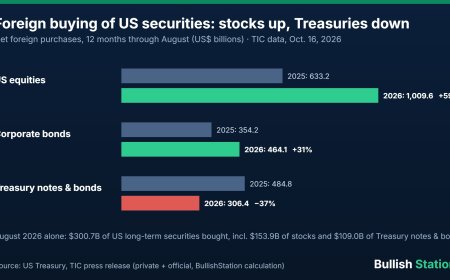
Latest data: TIC data: foreigners bought $300.7 billion of US securities in August as Treasury demand fades (Oct. 17, 2026)
Guide: Treasury yields and Bitcoin: how bond rates move crypto (2026 guide with data)
Related reading
- Macroeconomics explained for crypto investors
- US CPI September 2026: inflation at 3.7%
- US producer prices jump 1.3% in September
- Fed's Hammack and the 10-year yield above 5%
- Fed rate decisions and Bitcoin: FOMC tracker
- Bitcoin ETF flows tracker
Sources
- IMF, World Economic Outlook database, October 2026 (dataset IMF.RES:WEO): data.imf.org; IMF DataMapper: imf.org/external/datamapper
- IMF, Fiscal Monitor, October 2026, "Taxing Better to Boost Growth": imf.org
- IMF, Fiscal Monitor, April 2026: imf.org
- IMF, World Economic Outlook, October 2026, Chapter 1: imf.org (PDF)
- US Treasury, statement by Secretary Scott Bessent to the IMFC and Development Committee, October 14, 2026: home.treasury.gov
- US Treasury, daily par yield curve rates: home.treasury.gov
- US Treasury, Debt to the Penny and Monthly Treasury Statement: fiscaldata.treasury.gov
- CBO, Monthly Budget Review: September 2026 (October 8, 2026): cbo.gov
- IMF Media Center, Fiscal Monitor press briefing, Annual Meetings 2026: mediacenter.imf.org
- CoinGecko, Bitcoin price: coingecko.com
This article is for information only and is not investment advice. Forecasts can change and crypto assets are volatile: you can lose all the money you invest.
What's Your Reaction?
 Like
0
 Dislike
0
 Love
0
 Funny
0
 Wow
0
 Sad
0
 Angry
0











Comments (0)