

Solana Switches On Alpenglow: Finality Drops From 12.8 Seconds to 150 Milliseconds, but SOL Still Slips 3%
Solana activated the Alpenglow consensus on October 21. Anza says finality fell from 12.8 seconds to 150 milliseconds, with 654 validators in the handoff. What changes for validators, and why SOL still fell.

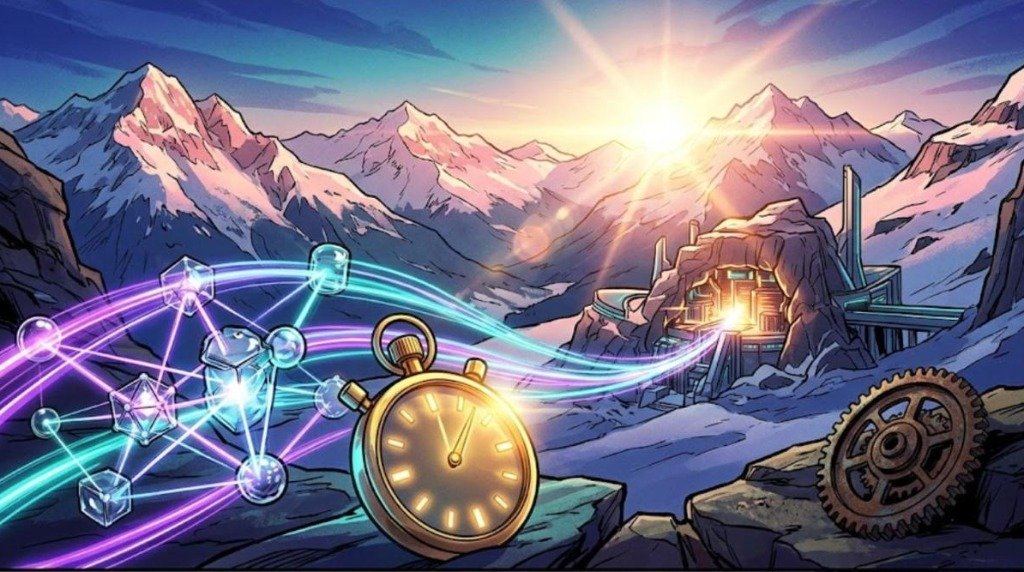
Published October 23, 2026 (Alpenglow activated on Solana mainnet on October 21, 2026).
Quick take
- Solana replaced its TowerBFT consensus with Alpenglow on October 21; Anza says finality fell from 12.8 seconds to 150 milliseconds.
- 654 validators took part in the switch, which Anza says took 900 milliseconds at slot 459,653,000.
- SOL still fell about 3% by October 23, in line with Bitcoin's drop.
Solana switched its mainnet to a new consensus protocol called Alpenglow on Wednesday, October 21, cutting the time to finalize a transaction from 12.8 seconds to about 150 milliseconds, according to core developer Anza.
It is the deepest change to how Solana agrees on blocks since its mainnet beta opened in March 2020. By BullishStation's count, finality is now about 85 times faster, a 98.8% cut.
"Alpenglow is live on mainnet-beta," Anza wrote on X at 13:54 UTC. In the same thread, the firm said "the legacy TowerBFT is retired." It listed the handoff details: genesis slot 459,653,000, activation epoch 1064, 654 participating validators and a 900-millisecond handoff.
The change is set out in SIMD-0326, written by Quentin Kniep, Kobi Sliwinski and Roger Wattenhofer. It replaces the old Proof-of-History-based voting and TowerBFT with a component called Votor. Validators now exchange votes directly instead of posting them as on-chain transactions.
The rules are simple on paper. A block is finalized in one round if validators holding 80% of stake vote for it, or in two rounds at 60%. "Compared to the old protocol, Alpenglow offers higher resilience and better performance," the proposal states.
Validators also pay differently. Today they spend roughly 1 SOL a day on vote transactions. The proposal replaces that with a Validator Admission Ticket of about 0.8 SOL a day, or 1.6 SOL per epoch, which is burned. At Friday's price near $104.60, that is roughly $30,500 a year per validator, by BullishStation's count. The active set is capped at the 2,000 highest-staked validators.
What 150 milliseconds means next to Ethereum and Bitcoin
The comparison is striking. Under Ethereum's current design, finality takes two epochs of 32 twelve-second slots, or about 12.8 minutes; Solana's new figure is roughly 5,000 times shorter. Bitcoin has no formal finality, and the common six-confirmation rule takes about an hour. Our guide to layer 1 and layer 2 blockchains explains why these designs differ, and Ethereum's own plans are covered in our piece on the Lean roadmap.
Anza is pitching speed to finance. "Institutions: settlement in 150ms with a cryptographic guarantee," it wrote, adding that AI agents get "permissionless payments at agentic speed." Both themes run through the race to tokenize stocks and agent payment standards such as x402.
That said, the upgrade is only half of Alpenglow. Rotor, the new way of spreading block data, is not part of SIMD-0326; Solana keeps its Turbine protocol for now, and Rotor will get its own proposal. The design also gives up classic one-third Byzantine fault tolerance in exchange for one-round finality and resilience to crashes of up to 40% of stake, a trade-off the SIMD describes as its "20+20" model.
The market shrugged. SOL traded at $106.88 an hour before activation and $103.54 at midnight UTC on October 23, down 3.1%, according to CoinGecko. Bitcoin fell 3.3% on October 22 alone. US spot Solana ETFs saw net outflows of $17.6 million from October 19 to 22, per Farside Investors, though they still hold $1.53 billion of cumulative net inflows.
History explains why reliability matters more than speed here. Solana's early years were marked by outages, including a roughly five-hour halt in February 2024. Anza first presented Alpenglow in May 2025, and validators approved SIMD-0326 in a stake-weighted vote that September, with about 99% of votes cast in favor, according to Blockworks. Delivery took 13 months.
The next few days will tell more. Each Solana epoch lasts about two days, so the first full epochs under Alpenglow will show whether 150 milliseconds holds under real load. For SOL's price, the Fed's decision on Wednesday, October 28, is likely to matter more than block times, as Thursday's broad sell-off showed.
Related: Robinhood Chain and tokenized stocks · What is Web3? DeFi, blockchain and tokenization explained
Sources: Anza, Alpenglow mainnet announcement (X thread), October 21, 2026; SIMD-0326 Alpenglow proposal; Anza, "Alpenglow: A New Consensus for Solana," May 19, 2025; CoinGecko; Farside Investors, Solana ETF flows; Blockworks, governance vote.
This article is for information only and is not investment advice. Crypto assets are volatile and you can lose all of your capital. Performance figures are those reported by Anza and may vary under network load.
What's Your Reaction?
 Like
0
 Dislike
0
 Love
0
 Funny
0
 Wow
0
 Sad
0
 Angry
0











Comments (0)