

US Consumer Sentiment Holds Near Record Lows at 48.0 as Long-Run Inflation Expectations Climb to 3.5%
The University of Michigan's final October sentiment index was 48.0, while long-run inflation expectations rose to 3.5%, the highest since May, days before the Fed meets.


Quick take
- Michigan's final October sentiment index came in at 48.0, barely changed from September and 10.4% lower than a year earlier.
- Long-run inflation expectations rose to 3.5% and year-ahead expectations to 4.7%, both the highest since May.
- The five weakest monthly sentiment readings since 1978 have all come in 2026.
US consumer sentiment stayed close to record lows in October, with the University of Michigan's final index at 48.0 on Friday, Oct. 23, while long-run inflation expectations climbed to 3.5%.
The headline barely moved: September's reading was 48.1. The detail is what matters. Year-ahead inflation expectations rose to 4.7% from 4.6%, and the five-to-ten-year gauge rose to 3.5% from 3.4%, according to the Surveys of Consumers final October release. Both are the highest since May.
That combination is the one central bankers dislike most. Households feel poorer, yet they expect prices to keep rising. Long-run expectations are now above the 2.8% to 3.2% range seen throughout 2024, the survey said.
"Purchasing power continues to dominate consumer views of the economy," survey director Joanne Hsu wrote in the release. Sentiment is "now 10% below a year ago and 15% less than February, just prior to the Iran conflict," she added.
A record that keeps getting rewritten
The weakness is not a one-month story. By BullishStation's count of the index history published by the St. Louis Fed (FRED), which runs monthly since 1978, the five lowest readings ever recorded are all from 2026: May (44.8), October (48.0), September (48.1), June (49.5) and April (49.8). The previous floor, 50.0 in June 2022, now ranks only sixth.
The current-conditions gauge fell 8.3% to 46.7 in October. Hsu said that decline "was driven entirely by buying conditions for durables, which plunged 18% on the basis of higher interest rates and rising concerns about the affordability of such purchases." The expectations index, by contrast, rose 5.4% to 48.8.
The survey also published a special report on Friday, titled "Risks of Entrenchment." In it, Hsu compared today's expectations with a decade of web-based interviews and warned that recent moves "echo patterns seen in the initial inflationary episodes of the 1960s and 70s." Her conclusion was blunt: "The fact that inflation expectations are currently picking up suggests that consumers do not expect meaningful disinflation for the foreseeable future," she wrote in the report.
Those expectations are running well ahead of actual data. September's consumer price index rose 3.7% from a year earlier, as we reported in our September CPI breakdown. Consumers expect a full point more over the next twelve months. Our US inflation tracker shows the monthly path since last autumn.
Why this matters for the Fed and for Bitcoin
The timing matters. The Federal Reserve meets on Oct. 27 and 28, already with a 3.75% to 4.00% target range after its September hike, as logged in our FOMC tracker. Rising long-run expectations are the clearest argument against any easing, because the Fed treats them as a test of its credibility.
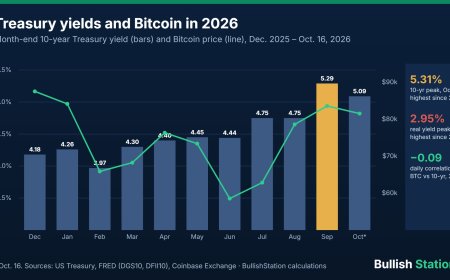
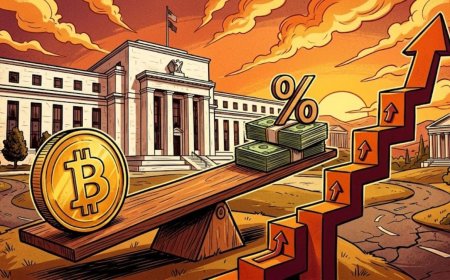
The chain to crypto runs through rates. If policymakers see expectations drifting, they keep policy tight for longer. Tighter policy holds real yields up, as our guide to Treasury yields and Bitcoin explains. High real yields tend to cool demand for risk assets, and that shows up in fund flows. US spot Bitcoin ETFs lost $635.6 million on Oct. 22 alone, according to our ETF flows tracker.
That said, the survey is not a forecast of Fed action. It measures what households believe, and those beliefs have swung with gasoline prices all year. Expectations rose in May, eased over the summer as fuel prices fell, then turned higher again in September, the special report noted.
Europe offers a useful contrast. In the ECB's Consumer Expectations Survey, also published on Oct. 23, euro-area consumers expected 3.1% inflation over the next year, up from 3.0%. Their three-year and five-year expectations held at 2.9% and 2.5%. In other words, US households expect year-ahead inflation 1.6 points higher than their European peers.
History offers a guide to why economists watch this gauge so closely. In the 1970s, expectations that drifted upward fed into wage demands and pricing, and the Fed eventually needed far higher rates to break them. Hsu's report stops short of saying that is happening now, writing that entrenchment "may not be inevitable."
The next test comes quickly. The Fed announces its decision on Wednesday, Oct. 28, at 2 p.m. ET. The preliminary November sentiment reading follows on Friday, Nov. 6, and the October CPI on Tuesday, Nov. 10.
Related: How Fed interest rates affect Bitcoin · The US dollar and Bitcoin
Sources: University of Michigan Surveys of Consumers, final October 2026 results (Oct. 23, 2026) · "Risks of Entrenchment" special report (Oct. 23, 2026) · FRED, UMCSENT series · ECB Consumer Expectations Survey, September 2026 (Oct. 23, 2026)
This article is for information only and is not investment advice. Crypto-assets are volatile and you can lose all of your capital.
What's Your Reaction?
 Like
0
 Dislike
0
 Love
0
 Funny
0
 Wow
0
 Sad
0
 Angry
0













Comments (0)