

What Is Real-World Asset (RWA) Tokenization? Market Size, Products and Risks
Real-world asset tokenization explained: how tokenized Treasuries, credit, gold and stocks work, the $39 billion on-chain market in 2026, the biggest products, regulation and risks.

Last updated: October 10, 2026
Key takeaways
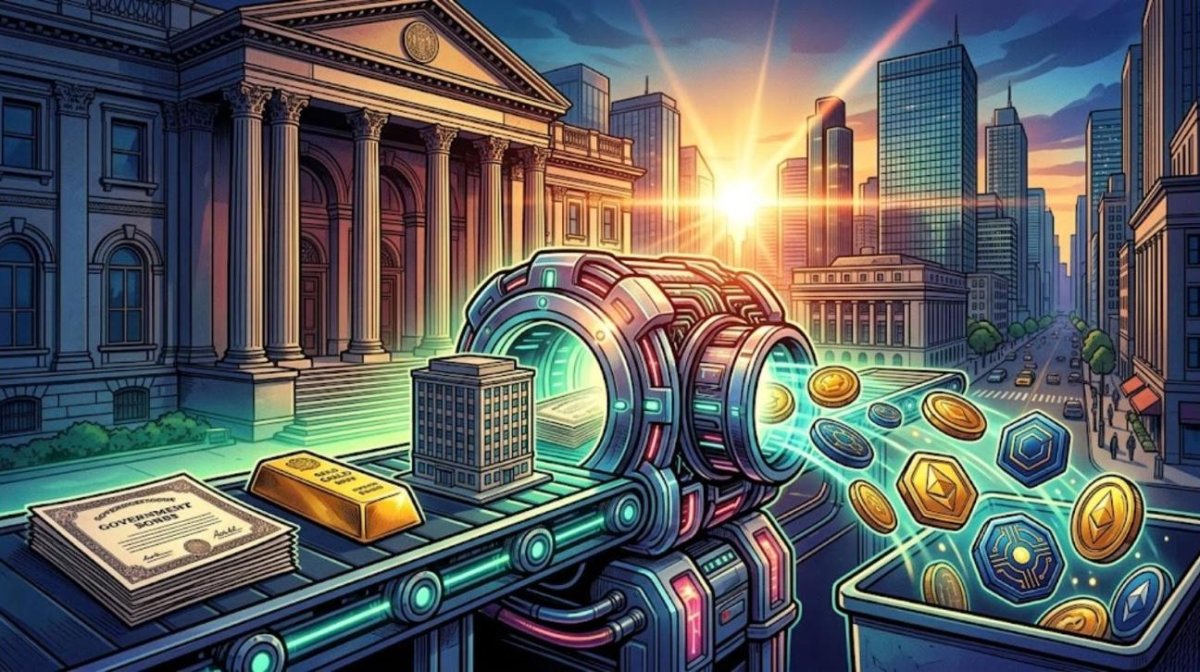
Real-world asset (RWA) tokenization means representing ownership of a traditional asset, such as a Treasury bill, a loan, gold or a share, as a token on a blockchain. On October 10, 2026, about $39.1 billion of RWAs (excluding stablecoins) were held directly on public blockchains by more than 5.1 million holders, according to rwa.xyz. Tokenized US Treasuries are the largest category at $14.95 billion. Forecasts of $2 trillion to $16 trillion by 2030 imply growth of more than 50 times from today, so the sector is real but still early.
For the bigger picture, read What is Web3? DeFi, blockchain and tokenization explained.
What is RWA tokenization?
The Bank for International Settlements describes tokenization as recording claims on real or financial assets on a programmable platform, which merges messaging, reconciliation and transfer into a single step and allows "atomic" settlement, where cash and asset change hands at the same moment (BIS Annual Economic Report 2025). In practice, an issuer holds the real asset with a regulated custodian, and investors hold tokens that represent their claim on it.
How does tokenization work?
- The asset. A fund manager or issuer holds the underlying asset: Treasury bills, a loan portfolio, gold bars, shares.
- The legal wrapper. A fund, trust or special-purpose vehicle gives token holders an enforceable claim on the asset.
- The token. Ownership units are issued as tokens on a blockchain such as Ethereum, Solana or a Layer 2, often with transfer restrictions for approved investors.
- Records and data. A transfer agent keeps the official register, and price feeds (oracles) bring net asset values on chain.
- Use. Tokens can be transferred 24/7, used as collateral in DeFi or exchanges, and redeemed for cash with the issuer.
How big is the tokenized asset market?
| Category (on-chain, distributed) | Value | Share of total |
|---|---|---|
| Tokenized US Treasuries | $14.95B | 38% |
| Tokenized credit (loans and corporate debt) | $8.04B | 21% |
| Commodities (mostly gold) | $5.21B | 13% |
| Other (funds, equities, real estate…) | $10.92B | 28% |
| Total RWAs, excluding stablecoins | $39.12B | 100% |
Data: rwa.xyz, October 10, 2026 (commodities as of October 9); shares and the "other" line calculated by BullishStation. rwa.xyz also tracks about $358 billion of assets that are only recorded on a blockchain while ownership stays off chain; we exclude them here. Stablecoins, the largest tokenized asset of all, are covered in our guide What is a stablecoin?
The largest tokenized products
| Product | Issuer | Underlying | Size (Oct. 2026) |
|---|---|---|---|
| XAUT | Tether | Gold | about $3.0B |
| USYC | Circle | Short-term US Treasuries | $2.40B |
| USDY | Ondo | Treasuries and bank deposits | $2.32B |
| BUIDL | BlackRock (with Securitize) | Cash, T-bills, repos | $2.20B |
| PAXG | Paxos | Gold | about $1.81B |
| BENJI / iBENJI | Franklin Templeton | US government money fund | $0.77B / $1.71B |
Data: rwa.xyz Treasuries and rwa.xyz Commodities. Tokenized Treasury funds yielded about 3.64% (7-day average), which is why they are used as on-chain "cash" by crypto funds, DAOs and exchanges.
Tokenized stocks and the regulatory picture
- European Union. The DLT Pilot Regime has applied since March 23, 2023, allowing market infrastructures to trade and settle tokenized shares, bonds and funds within size caps (ESMA). Tokenized securities remain securities; MiCA, fully applicable since December 30, 2024, covers crypto-assets not already regulated as financial instruments (ESMA, MiCA).
- United States. Nasdaq filed on September 8, 2025 to trade tokenized versions of listed securities settled through DTC (Proskauer). SEC Chair Paul Atkins and Commissioner Hester Peirce have described a narrow "innovation exemption" for limited trading of tokenized securities, while stressing that tokenized securities are still securities (The Block, February 2026). For the wider rulebook, see our coverage of the SEC's Regulation Crypto Assets and the CFTC's crypto asset market rules.
- Brokers. Robinhood launched more than 200 US stock and ETF tokens for EU customers on June 30, 2025, first on Arbitrum (Robinhood). Read our analysis of Robinhood Chain and tokenized stocks.
- Asia. Singapore's Project Guardian pilots tokenization with banks under the central bank's supervision.
How big could it get? Forecasts vs. reality
| Forecast for 2030 | Source and date | Multiple of today's $39B |
|---|---|---|
| About $2 trillion (range $1T–$4T) | McKinsey, 2024 | about 51x |
| $5.5 trillion of tokenized securities | Citi GPS, June 2026 | about 141x |
| $16.1 trillion | BCG / ADDX, September 2022 | about 412x |
Our calculation: even the most cautious forecast, McKinsey's $2 trillion, would require the on-chain market to grow about 155% a year from now to 2030. Growth is driven by interest rates and liquidity too: when yields fall, tokenized Treasury funds become less attractive, as our guide How macroeconomics drives crypto markets explains.
Risks of tokenized assets
- Legal enforceability: the token is only as good as the legal structure that ties it to the asset, and rules differ across borders (BIS).
- Issuer and custody risk: holders depend on the issuer and custodian actually holding the asset.
- Liquidity and redemption: many products allow redemption only through the issuer, for approved investors, on business days. Tokenized Treasury assets fell 5.5% in the 30 days to October 10, 2026, a reminder that money moves out quickly when yields or sentiment change.
- Technology risk: smart contract bugs, price-feed errors and blockchain outages.
- Fragmentation: tokens on different chains and platforms are not always interoperable.
FAQ
What are real-world assets in crypto?
Traditional assets such as government bonds, loans, gold, real estate or shares whose ownership is represented by tokens on a blockchain.
Is tokenization the same as a stablecoin?
A fiat-backed stablecoin is a tokenized claim on cash and short-term assets, but it is usually counted separately. RWA statistics normally exclude stablecoins.
What is the largest tokenized Treasury fund?
In October 2026, Circle's USYC, Ondo's USDY and BlackRock's BUIDL each held between $2.2 billion and $2.4 billion, according to rwa.xyz.
Can anyone buy tokenized assets?
Not always. Many tokenized funds are limited to qualified or institutional investors, and tokenized stocks are only offered in some jurisdictions.
Are tokenized stocks real shares?
It depends on the structure. Some represent the share itself; others are derivatives or claims that may not carry voting or shareholder rights. Check the product documents.
Related reading: What is a stablecoin? · Circle's OCC national trust bank approval · How institutional money flows shape crypto prices · What is a DAO? · Web3 coverage
Sources: rwa.xyz (data as of Oct. 10, 2026) · BIS Annual Economic Report 2025 · ESMA, DLT Pilot Regime · MAS, Project Guardian · McKinsey · Robinhood newsroom
This guide is for information only and is not investment advice. Tokenized assets carry risks, including the loss of capital.
What's Your Reaction?
 Like
0
Like
0
 Dislike
0
Dislike
0
 Love
0
Love
0
 Funny
0
Funny
0
 Wow
0
Wow
0
 Sad
0
Sad
0
 Angry
0
Angry
0








Comments (0)