

The Bitcoin Halving Explained: How It Works, When the Next One Is and What It Means for Price
Everything about the Bitcoin halving: how the block reward is cut every 210,000 blocks, the four halvings so far, the next one expected in March-April 2028, and why its effect on the price has faded.

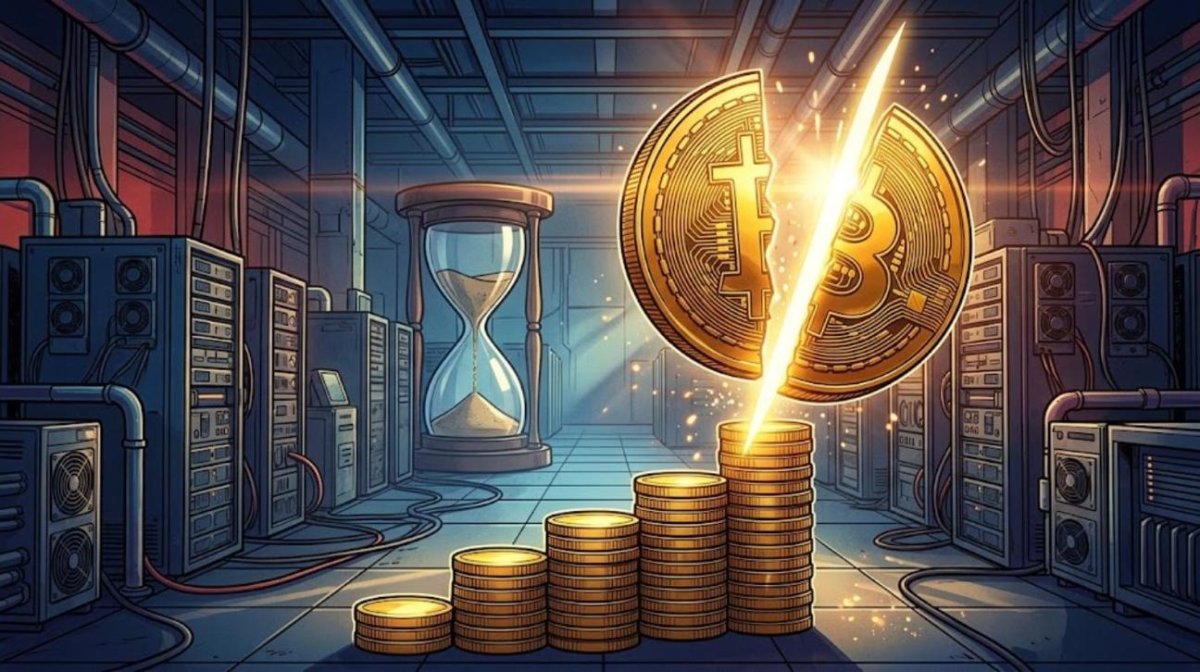
Last updated: October 13, 2026. The Bitcoin halving is the rule that cuts the number of new bitcoins created in each block by half, roughly every four years. It is the reason Bitcoin's supply is capped at 21 million, and one of the most discussed events in crypto. This guide explains how the halving works, what the four halvings so far changed, when the next one is expected, and why its effect on the price looks smaller in 2026 than it did a decade ago.
Key takeaways
- What it is: every 210,000 blocks, the reward paid to miners for a new block is divided by two. It is written into Bitcoin's code and needs no decision from anyone.
- Where we are: the fourth halving, on April 20, 2024 at block 840,000, cut the reward from 6.25 to 3.125 BTC. About 450 new bitcoins are now created per day, an annual issuance of roughly 0.8% of supply.
- Next halving: at block 1,050,000, expected between mid-March and mid-April 2028 on our calculation (about 78,700 blocks away on October 13, 2026). The reward will fall to 1.5625 BTC.
- Price history: one year after each halving, Bitcoin was up 282% (2016), 562% (2020) and 31% (2024) on Coinbase data. The effect has shrunk as new supply became tiny compared with ETF flows and macro forces such as Fed interest rates.
- About 95.7% of all bitcoins that will ever exist are already issued; the last fractions will be mined around the year 2140.
What is the Bitcoin halving?
New bitcoins enter circulation in one way only: as a reward to the miner who adds a new block to the blockchain. When Bitcoin launched in January 2009, that reward was 50 BTC per block. Satoshi Nakamoto's white paper describes this "incentive" as the way coins are initially distributed, with a predetermined number of coins entering circulation.
The schedule is enforced by every Bitcoin node. In Bitcoin Core, the reference software, the function GetBlockSubsidy divides the block height by the halving interval, 210,000 blocks, and halves the 50 BTC starting reward once for each completed interval (Bitcoin Core source code; the interval is set in chainparams.cpp). A block that pays its miner more than allowed is rejected by the network. No company, foundation or vote decides the halving; changing it would require almost every user to adopt different software.
Because blocks arrive about every 10 minutes on average, 210,000 blocks take about four years. The exact date depends on how fast blocks are found, which is why halving dates are always estimates until the block is mined.
New to Bitcoin itself? Start with our guide What is Bitcoin?
Every Bitcoin halving so far
| Halving | Date | Block | Reward (BTC) | New BTC per day after | Supply at the halving | Annual issuance after |
|---|---|---|---|---|---|---|
| Launch | Jan 3, 2009 | 0 | 50 | 7,200 | 0 | n/a |
| 1st | Nov 28, 2012 | 210,000 | 50 → 25 | 3,600 | 10.5M (50.0%) | 12.5% |
| 2nd | Jul 9, 2016 | 420,000 | 25 → 12.5 | 1,800 | 15.75M (75.0%) | 4.2% |
| 3rd | May 11, 2020 | 630,000 | 12.5 → 6.25 | 900 | 18.375M (87.5%) | 1.8% |
| 4th | Apr 20, 2024 | 840,000 | 6.25 → 3.125 | 450 | 19.6875M (93.75%) | 0.8% |
| 5th (next) | Mar–Apr 2028 (est.) | 1,050,000 | 3.125 → 1.5625 | 225 | 20.34M (96.9%) | 0.4% |
BullishStation calculation from the protocol schedule: supply = 210,000 × 50 × (2 − 21−n) after the n-th halving; daily issuance assumes 144 blocks per day; annual issuance = new coins per year ÷ supply at the halving. Actual circulating supply is very slightly lower because a few early block rewards were never claimed. Block data can be checked on any explorer, for example block 840,000 on mempool.space.
The table shows the core idea: each halving matters less in absolute terms. The first one removed 3,600 new bitcoins a day from the market; the next one will remove 225. By 2028, more than 96% of all bitcoins will already exist.
When is the next Bitcoin halving?
On October 13, 2026, the Bitcoin blockchain was at block 971,276 (mempool.space). The fifth halving happens at block 1,050,000, which is 78,724 blocks away.
| Assumption | Average time per block | Estimated date of the 5th halving |
|---|---|---|
| Protocol target | 10 minutes | around April 12, 2028 |
| Recent pace (current difficulty period) | about 9.5 minutes | around March 18, 2028 |
Our calculation. Recent pace from the mempool.space difficulty data (average of about 572 seconds per block in the current period). Blocks come faster when hashrate is growing; every 2,016 blocks the difficulty adjusts to bring the average back toward 10 minutes, so the real date usually lands between these two estimates.
What the halving means for miners
Miners earn two things for each block: the block subsidy (the part that halves) and the transaction fees paid by users. At 3.125 BTC per block and a Bitcoin price of about $83,350 (Coinbase close, October 13, 2026), the subsidy alone is worth about $37.5 million a day to the mining industry. The next halving will cut that by half overnight, unless the price or fees rise.
Historically, halvings have pushed the least efficient miners out, consolidated the industry around large, listed companies with cheap power, and pushed miners to diversify into AI and high-performance computing hosting. Over the long run, as the subsidy shrinks toward zero, Bitcoin's security budget has to come mostly from transaction fees. That is one of the open questions about Bitcoin's design.
Does the halving make the price go up?
The popular theory is simple: if demand stays the same and new supply falls, the price should rise. The data show that this worked spectacularly in Bitcoin's early cycles, and much less recently.
| Halving | BTC price on halving day | 12 months later | Change |
|---|---|---|---|
| Jul 9, 2016 | $657.61 | $2,508.99 (Jul 9, 2017) | +281.5% |
| May 11, 2020 | $8,572.40 | $56,753.19 (May 11, 2021) | +562.0% |
| Apr 20, 2024 | $64,968.87 | $85,177.34 (Apr 20, 2025) | +31.1% |
| Apr 20, 2024 | $64,968.87 | $83,346.45 (Oct 13, 2026, 30 months later) | +28.3% |
Source: Coinbase Exchange daily closing prices (UTC), public market data. Changes calculated by BullishStation. Coinbase data do not cover the 2012 halving. Past performance does not predict future results.
Three reasons explain why the halving effect has faded:
- The supply shock is smaller. In 2016 the halving removed about 4% of annual supply growth; in 2024, about 0.8%. Today, about 450 new bitcoins a day are worth roughly $37 million. US spot Bitcoin ETFs can move ten times that in a single session: they lost $484.9 million on October 7, 2026 alone (see our Bitcoin ETF flows tracker and how ETF flows move the price).
- The halving is known in advance. Its date is predictable to within weeks, years ahead. Efficient markets tend to price in what everyone can see coming.
- Macro now dominates. Since 2020, Bitcoin has traded more and more like a global liquidity asset. Interest rates, the dollar and inflation now explain much of its moves: the Fed's September 2026 rate hike (Fed tracker) and inflation at 3.4% (CPI tracker) weigh on the price far more than 225 fewer coins a day will in 2028. Our guide to liquidity and institutional flows explains the mechanism.
This does not mean the halving is irrelevant. It makes Bitcoin's monetary policy fully predictable, which is a core part of its appeal as "digital scarcity", and it steadily reduces the selling pressure from miners, who must sell part of their rewards to pay for power. But the idea of a mechanical four-year cycle driven by the halving alone is not supported by the most recent cycle.
The halving and Bitcoin's 21 million cap
Because the reward halves every 210,000 blocks, total issuance follows a geometric series: 210,000 × (50 + 25 + 12.5 + …), which converges to just under 21 million BTC. After 64 halvings the reward drops to zero in Bitcoin Core's code, around the year 2140. On our calculation, about 20.10 million BTC (95.7%) had been issued by October 13, 2026, leaving about 900,000 to be mined over the next 114 years.
Compare that with a central bank: the money supply of the dollar or euro is set by policy decisions, which is exactly what macro-focused investors watch. Bitcoin's issuance is fixed in code, and its annual inflation rate (about 0.8% today) is already lower than the Federal Reserve's 2% inflation target.
Halving vs. other crypto supply models
- Bitcoin: fixed schedule, halving every 210,000 blocks, hard cap of 21 million.
- Ether: no halving and no hard cap. Issuance depends on the amount staked, and part of the fees is burned, so supply can rise or fall. See our guide to Ethereum Layer 1 and Layer 2.
- Bitcoin forks and copies (Litecoin, Bitcoin Cash) use similar halving schedules with different intervals.
- Stablecoins: supply follows demand, since each token is meant to be backed by reserves. See What is a stablecoin?
FAQ
What is the Bitcoin halving in simple terms?
It is the moment, every 210,000 blocks (about four years), when the number of new bitcoins paid to miners for each block is cut in half. It slows the creation of new bitcoins until the 21 million cap is reached.
When is the next Bitcoin halving?
At block 1,050,000, expected between mid-March and mid-April 2028 depending on the pace of block production. The block reward will fall from 3.125 to 1.5625 BTC.
When was the last Bitcoin halving?
On April 20, 2024, at block 840,000. The reward fell from 6.25 to 3.125 BTC.
How many Bitcoin halvings will there be?
Bitcoin Core's code stops paying a subsidy after 64 halvings, around the year 2140. In practice the reward becomes smaller than the smallest unit of bitcoin (one satoshi) after 33 halvings.
Does the halving increase the price of Bitcoin?
Not automatically. Bitcoin rose strongly in the year after the 2016 and 2020 halvings, but only 31% after the 2024 halving, on Coinbase data. Today, ETF flows, interest rates and global liquidity have a larger effect on the price than the reduction in new supply.
Can the halving be changed or cancelled?
Only if the vast majority of Bitcoin users, miners and node operators adopted new software with a different rule, which has never happened and would be highly controversial. Nodes reject any block that pays more than the scheduled reward.
Latest mining news: Binance is closing its Bitcoin mining pool on November 10: the hashrate data
Related reading: What is Bitcoin? · How Fed interest rates affect Bitcoin · What are Bitcoin ETFs? · Bitcoin ETF flows tracker · Fed rate decisions tracker · CPI & crypto tracker · Why is Bitcoin down today? · Liquidity and institutional flows
Sources: Satoshi Nakamoto, Bitcoin white paper (2008) · Bitcoin Core, validation.cpp (GetBlockSubsidy) · Bitcoin Core, chainparams.cpp (halving interval) · mempool.space (block height, difficulty) · Coinbase Exchange market data · Farside Investors (ETF flows)
Related: UK court rules Chinese law decides claims to 61,000 seized bitcoin (October 14, 2026).
Update, October 14, 2026: Strategy now buys well under one day of new bitcoin supply per week: see its October 13 SEC filing compared with five weeks of 8-Ks.
This guide is for information only and is not investment advice. Crypto-assets are volatile and you can lose all of your capital.
What's Your Reaction?
 Like
0
 Dislike
0
 Love
0
 Funny
0
 Wow
0
 Sad
0
 Angry
0











Comments (0)