

What Are Perpetual Futures? Funding Rates, Leverage and Liquidations Explained (2026)
A plain-English guide to perpetual futures: how funding rates keep prices anchored, what funding costs over a year, how leverage and liquidation work, and the new US rules in 2026.

Updated October 17, 2026. Perpetual futures, or "perps", are the most traded product in crypto, and in 2026 they are moving onto regulated US exchanges, including contracts on US stocks. This guide explains in plain English how a perpetual works, what the funding rate is, how leverage and liquidation work, and how the new US rules differ from offshore crypto venues.
Key takeaways
- A perpetual future is a futures contract with no expiry date. Instead of settling on a fixed day, it uses periodic funding payments between buyers and sellers to stay close to the price of the underlying asset.
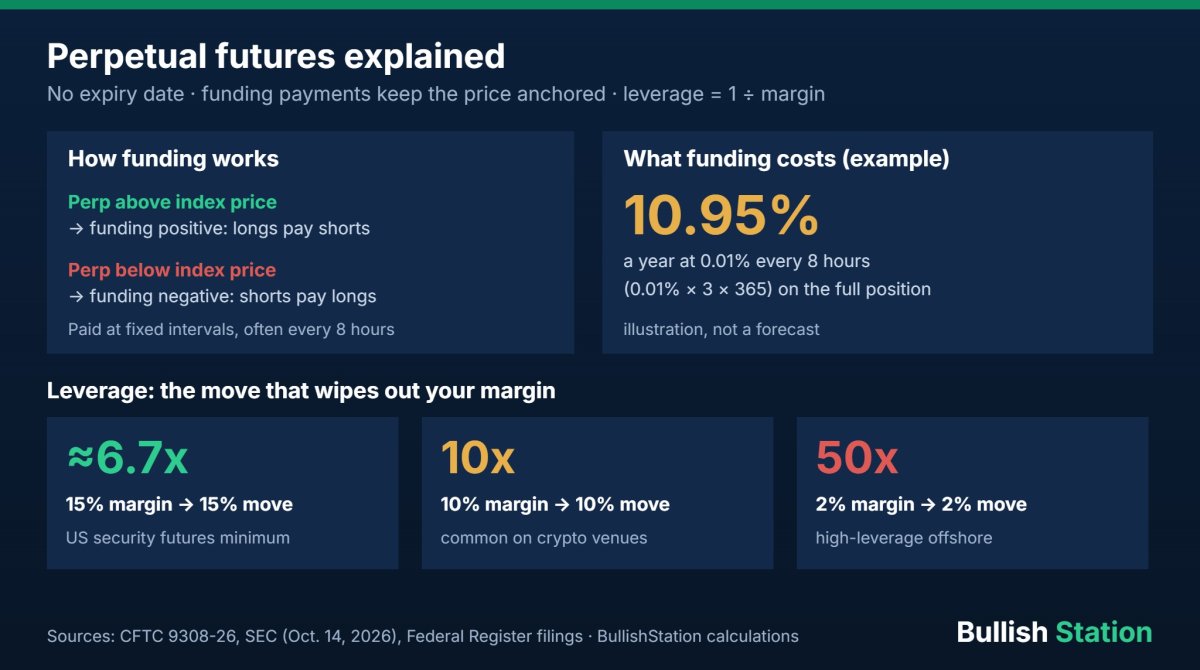
- Funding is the hidden cost: a rate of 0.01% every 8 hours adds up to about 10.95% a year for the side that pays.
- Leverage cuts both ways: with 15% margin (the US minimum for security futures), a 15% move against you wipes out your initial margin; with 2% margin (50x), a 2% move does.
- The US is catching up: the CFTC has allowed perpetual-style futures on regulated exchanges, and in September 2026 five exchanges notice-registered with the SEC to list security futures, with at least four expected to trade perpetuals on securities this quarter.
How a perpetual future works
A classic future is an agreement to buy or sell an asset at a set price on a set date. As that date approaches, the future converges to the spot price. A perpetual removes the date. To stop its price drifting away from the underlying, exchanges add a funding mechanism:
- When the perpetual trades above the underlying (index) price, the funding rate is positive and longs pay shorts.
- When it trades below, the rate is negative and shorts pay longs.
- Payments are made at fixed intervals, often every 8 hours on crypto exchanges.
This pushes traders to sell when the contract is too expensive and buy when it is too cheap, which keeps the price anchored. The design was popularised by the crypto exchange BitMEX in 2016 and is now standard across crypto venues.
The US rule filings use the same building blocks. Coinbase Derivatives' rulebook for security futures defines a "Funding Rate", a "Funding Interval" and "Funding Payments", and notes the "absence of a scheduled final settlement". Nadex describes "periodic real-time pricing mechanism cash adjustments" at 00:00, 08:00 and 16:00 UTC.
Worked example 1: what funding costs
| Funding rate per 8 hours | Per day (3 payments) | Per year (×365) | On a $10,000 position, per year |
|---|---|---|---|
| 0.005% | 0.015% | 5.48% | $548 |
| 0.01% | 0.03% | 10.95% | $1,095 |
| 0.03% | 0.09% | 32.85% | $3,285 |
Our calculation, simple (non-compounded) sums, for illustration only. Funding rates change at every interval and can turn negative. Funding is paid on the full position size, not on the margin, so it weighs more as leverage rises.
Worked example 2: leverage and liquidation
| Initial margin | Maximum leverage | Adverse move that wipes out the margin | Typical venue |
|---|---|---|---|
| 15% | ≈6.7x | 15% | US security futures minimum |
| 10% | 10x | 10% | Common on crypto venues |
| 2% | 50x | 2% | High-leverage offshore crypto venues |
Our calculation: leverage = 1 ÷ margin. In practice, exchanges liquidate earlier, when equity falls below the maintenance margin, and fees and funding reduce the cushion further. A Bitcoin move of 2% happens on many trading days, which is why high-leverage positions are liquidated so often.
Perpetuals vs other ways to get exposure
| Spot (buy the asset) | Spot ETF | Dated future | Perpetual future | |
|---|---|---|---|---|
| Expiry | None | None | Fixed date | None |
| Leverage | None (unless borrowed) | None | Yes | Yes |
| Ongoing cost | Custody | Management fee | Roll cost between contracts | Funding payments |
| Can go short | No | No | Yes | Yes |
| Can lose more than invested | No | No | Margin can be wiped out | Margin can be wiped out |
See our guide What are Bitcoin ETFs for the spot ETF route.
Perpetuals in the US: where the rules stand in 2026
- CFTC: on October 5, 2026, its Division of Market Oversight issued no-action relief letting exchanges convert "perpetual-style" broad-based index futures into "true" perpetual futures by removing expiration dates, subject to customer protection conditions. That relief expires on October 20, 2026.
- SEC: security futures (on single stocks or narrow indices) fall under joint SEC/CFTC oversight. SEC Trading and Markets Director Jamie Selway said on October 14 that five CFTC-registered exchanges filed Form 1-N notices in September and that he expects "at least four to begin to trade perpetual futures on securities sometime this quarter."
- Margin floor: customer margin on security futures cannot be below 15% of market value, a standard cited in Coinbase Derivatives' margin filing.
- For the details of the stock perpetuals coming this quarter, see our news on perpetual futures on US stocks.
Risks to know before trading perpetuals
- Liquidation: a sudden move can close your position automatically, often at the worst moment.
- Funding drift: in strong bull markets, longs can pay high funding for weeks.
- Venue risk: offshore exchanges may not be authorised in your country. In the EU, crypto derivatives fall under financial-instruments rules (MiFID II), not MiCA.
- Price gaps: perpetuals on stocks may trade while the underlying exchange is closed, so prices can jump when it reopens.
FAQ
Why are they called perpetual?
Because they never expire. You can hold the position as long as you keep enough margin and pay or receive funding.
Who receives the funding payment?
The other side of the trade. Funding is exchanged between longs and shorts; the exchange does not keep it (it earns trading fees instead).
Is a positive funding rate bullish?
It shows that more traders want to be long than short at current prices. Very high funding often signals crowded positioning, not a guarantee of further gains.
Are perpetual futures legal in the US?
On regulated US exchanges, yes, within CFTC and SEC rules. Perpetual-style crypto futures have been listed on CFTC-regulated exchanges, and perpetuals on securities are expected to launch by the end of 2026.
Latest: Cboe can now list options on multi-crypto ETFs: which coins pass the $700 million test (October 2026).
Related reading: What are Bitcoin ETFs · CFTC crypto rules · Tokenized stocks compared · Crypto liquidity and institutional flows guide · What is Bitcoin · ETF flows tracker
Sources: CFTC, release 9308-26 (Oct. 5, 2026) · SEC, Jamie Selway remarks (Oct. 14, 2026) · Federal Register, Coinbase Derivatives security futures rules (91 FR 60448) · Federal Register, Coinbase Derivatives margin rules (91 FR 60670) · Federal Register, Nadex contract specifications (91 FR 62786)
This guide is for information only and is not investment advice. Leveraged derivatives are risky and you can lose your entire margin quickly. Do your own research.
What's Your Reaction?
 Like
0
 Dislike
0
 Love
0
 Funny
0
 Wow
0
 Sad
0
 Angry
0












Comments (0)