

Perpetual Futures on US Stocks Are Coming: 5 Exchanges Registered With the SEC, at Least 4 Expected to Launch This Quarter
Coinbase Derivatives, KalshiEX, Bitnomial, Nadex and ICE Futures U.S. registered as security futures exchanges in September. The SEC's trading chief expects at least four to launch perpetual futures on securities this quarter. We compare the filings.


Published October 17, 2026. Sources: SEC, CFTC and exchange rule filings. Information only, not investment advice.
Perpetual futures, the never-expiring contracts that dominate offshore crypto trading, are about to be offered on US stocks by regulated American exchanges. In a speech on October 14, the SEC's top market-structure official said five CFTC-regulated futures exchanges registered with the SEC in September to trade security futures, and that "at least four" should start trading perpetual futures on securities this quarter. We read the filings to compare what each venue has proposed.
Key takeaways
- Five exchanges registered: Coinbase Derivatives, KalshiEX, Bitnomial Exchange, Nadex and ICE Futures U.S. filed Form 1-N with the SEC between September 1 and September 30, 2026, becoming notice-registered security futures exchanges under Section 6(g) of the Exchange Act.
- Launch window: Jamie Selway, Director of the SEC's Division of Trading and Markets, said: "I expect at least four to begin to trade perpetual futures on securities sometime this quarter."
- Three detailed rulebooks so far: Coinbase, KalshiEX and Nadex filed product rules for perpetual single-stock futures with minimum margins of 15% to 15.50%, which means maximum leverage of roughly 6.5x, far below offshore crypto venues.
- Index perpetuals first: a CFTC staff no-action letter (Letter 26-29, requested by Coinbase Derivatives) lets exchanges strip expiration dates from existing "perpetual-style" index futures. That relief expires on October 20, 2026.
- Not live yet: the single-stock products still need CFTC approval before they become effective, and the SEC can abrogate them after that.
What happened
Speaking at the Security Traders Association's 93rd Annual Market Structure Conference in Washington on October 14, Selway said: "In September, the Commission received Form 1-Ns from five CFTC-registered DCMs" (designated contract markets), naming Coinbase, Kalshi, Bitnomial, Nadex and ICE Futures. He also cited CME's launch of cash-settled single-stock futures on July 27 and the Commission's approval of the "Innovation Exemption" for tokenized securities venues on September 17, a topic we covered in our comparison of OKX-ICE, Securitize and Coinbase tokenized stocks.
He drew a line on what the SEC will accept: "A broker is not a bookie. Our capital markets are not a casino." He added that US equity markets are moving toward 23-hours-a-day, five-days-a-week trading, and possibly 24/7 later.
The five registrations, by date
| Exchange | Form 1-N filed | SEC notice | SEC release |
|---|---|---|---|
| Coinbase Derivatives | Sep 1, 2026 | Sep 8 | 34-106295 |
| KalshiEX | Sep 3, 2026 | Sep 8 | 34-106296 |
| Bitnomial Exchange | Sep 4, 2026 | Sep 8 | 34-106297 |
| Nadex | Sep 14, 2026 | Sep 16 | 34-106396 |
| ICE Futures U.S. | Sep 30, 2026 | Oct 1 | 34-106567 |
Source: SEC acknowledgement releases and Federal Register (October 6, 2026). Under Section 6(g), a CFTC-registered futures exchange's registration as a security futures exchange takes effect when it files Form 1-N; it covers security futures only.
How the three proposed contracts compare
| Coinbase Derivatives | KalshiEX | Nadex | |
|---|---|---|---|
| Filing | SR-COIN-2026-002 (Sep 18) | SR-KALSHIEX-2026-02 (Sep 18) | SR-OGM-2026-001 (Sep 24) |
| Underlyings | Single stocks and ETF shares | Single stocks | Single stocks |
| Contract size | Set in product appendix | 100 shares (fractions allowed) | 1 share |
| Initial eligibility | Market cap ≥ $100B, avg daily traded value ≥ $450M (6 months) | Same as Coinbase | Maintenance: cap ≥ $50B, ADTV ≥ $200M |
| Minimum margin | 15% | 15.50% | 15.05% |
| Max leverage (our calc.) | 6.7x | 6.5x | 6.6x |
| Trading hours | Sun 8 p.m. ET – Fri 5 p.m. ET | Sun 6 p.m. ET – Fri 5 p.m. ET (daily 5–6 p.m. break) | 24 hours, 5 days |
| Funding | Set in product appendix | Once a day at ~4 p.m. ET | Every 8 hours (00:00, 08:00, 16:00 UTC) |
| Status | Pending CFTC approval | Pending CFTC approval | Effective on CFTC approval |
Source: rule filings published by the SEC. Leverage = 1 ÷ minimum margin, BullishStation calculation. Bitnomial's and ICE's product rules were not available at the time of writing.
How a perpetual future works, in numbers
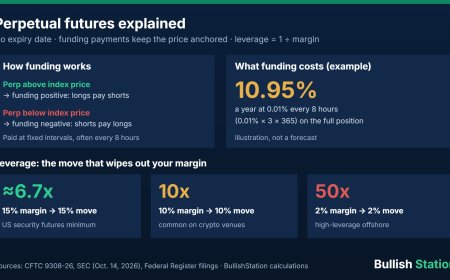
A perpetual has no expiry date. To keep its price close to the underlying stock, longs and shorts swap a periodic "funding" payment: when the perpetual trades above the stock, longs pay shorts; when it trades below, shorts pay longs.
- On Nadex's proposed schedule (three funding times a day), a funding rate of 0.01% per 8-hour period on a $10,000 position costs the long side $1 per period, $3 a day, or about 10.95% a year (0.01% × 3 × 365) if it stayed constant.
- With a 15% minimum margin, that same $10,000 position needs at least $1,500 of collateral. A 15% move against the position would wipe out the margin before any funding costs.
- KalshiEX instead exchanges funding once a day, at its daily settlement time, based on a premium computed every 60 seconds during US market hours.
Crypto traders know this mechanism well: perpetuals are the main derivative on offshore crypto exchanges. For background on how derivatives and fund flows move prices, see our guide to Bitcoin ETFs and flows.
The CFTC's October 20 deadline
On October 5, the CFTC announced (release 9308-26) that its Division of Market Oversight had issued no-action Letter 26-29 at the request of Coinbase Derivatives. Under it, exchanges "may remove expiration dates from their existing broad-based security index futures perpetual style futures contracts" without the usual 10-business-day filing period. Conditions include at least five calendar days' notice to holders, the option to close positions on the old terms, risk disclosures and no other material change. The letter states: "The no action positions in this letter expire on October 20, 2026." This follows the CFTC's broader crypto rule work we covered in CFTC crypto rules.
Why it matters for crypto markets
- Crypto exchanges move into equities: Coinbase and Bitnomial, both crypto derivatives venues, are among the first registrants. Their customers could trade stock perpetuals next to Bitcoin and Ether perpetuals in one regulated account.
- Onshore competition for offshore venues: regulated perpetuals with ~6.5x maximum leverage are a very different product from the high-leverage contracts offered offshore.
- Round-the-clock risk: stock perpetuals trading on Sundays and overnight could react to macro news before Wall Street opens, as crypto already does. See how Fed rates affect Bitcoin.
- Part of a wider SEC agenda: tokenized stocks, crypto custody rules (our analysis) and the Regulation Crypto Assets comment period are all moving at the same time.
Timeline
- Jul 27, 2026: CME launches cash-settled single-stock futures (cited by Selway).
- Sep 1–30: five Form 1-N filings.
- Sep 17: SEC approves the Innovation Exemption.
- Sep 18–24: Coinbase, KalshiEX and Nadex file perpetual single-stock rules.
- Oct 3–5: CFTC Letter 26-29 on index perpetual-style futures.
- Oct 14: Selway speech: "at least four" this quarter.
What to watch next
- October 20, 2026: expiry of the CFTC no-action relief for converting index futures into perpetuals.
- Coming weeks: CFTC approval of the single-stock rulebooks, which would make them effective; the SEC then has 60 days to abrogate.
- By December 31, 2026: first trading of perpetual futures on securities, if Selway's "this quarter" holds.
- Year-end: SEC review of Reg NMS Rules 610 and 612, which Selway said is "well underway".
- Daily ETF flows that show how institutions position: Bitcoin ETF Flows Tracker.
FAQ
What is a perpetual future?
A futures contract with no expiry date. A periodic funding payment between longs and shorts keeps its price close to the underlying asset.
Can US investors trade stock perpetuals today?
Not yet on these exchanges. The single-stock products filed by Coinbase, KalshiEX and Nadex still need CFTC approval. The SEC's trading chief expects at least four venues to start this quarter.
Which exchanges registered with the SEC?
Coinbase Derivatives, KalshiEX, Bitnomial Exchange, Nadex and ICE Futures U.S., all between September 1 and 30, 2026.
How much leverage is allowed?
Proposed minimum margins are 15% to 15.50%, which caps leverage at about 6.5x to 6.7x.
What happens on October 20?
The CFTC staff no-action relief for removing expiry dates from broad-based index "perpetual-style" futures expires.
Guide: What are perpetual futures? Funding rates, leverage and liquidations explained
Latest: Cboe can now list options on multi-crypto ETFs: which coins pass the $700 million test (October 2026).
Related reading
- Tokenized stocks: OKX-ICE, Securitize and Coinbase compared
- CFTC crypto rules
- SEC crypto custody proposal
- What are Bitcoin ETFs?
- Ether ETF outflows in October
- Bitcoin ETF Flows Tracker
Sources
- SEC, Jamie Selway, "How Soon is Now?", Oct 14, 2026: sec.gov
- SEC releases 34-106295 (Coinbase Derivatives), 34-106296 (KalshiEX), 34-106297 (Bitnomial), 34-106396 (Nadex): 106295, 106296, 106297, 106396
- Federal Register, ICE Futures U.S. notice (34-106567), Oct 6, 2026: govinfo.gov
- Rule filings: Coinbase SR-COIN-2026-002, KalshiEX SR-KALSHIEX-2026-02, Nadex SR-OGM-2026-001
- CFTC release 9308-26, Oct 5, 2026: cftc.gov; CFTC Letter 26-29: cftc.gov
Disclaimer: This article is for information only and is not investment advice. Futures and leveraged products carry a high risk of loss. BullishStation does not recommend buying or selling any asset.
What's Your Reaction?
 Like
0
 Dislike
0
 Love
0
 Funny
0
 Wow
0
 Sad
0
 Angry
0














Comments (0)