

CFTC Clears Perpetual Futures on US Stocks for the First Time, and Cboe and Citadel Sue Within Hours
The CFTC said perpetual futures on individual US stocks can begin trading after being deemed approved as security futures, while Cboe, Citadel Securities and Healthy Markets went to court to stop them.


Published November 4, 2026 (CFTC statement of November 3). Information only, not investment advice.
Quick take
- The CFTC says perpetual futures on individual US stocks can now trade on dual-registered US exchanges.
- Cboe, Citadel Securities and Healthy Markets sued the CFTC the same day to block the approvals.
- No exchange, stock list or launch date was named by the regulator.
The Commodity Futures Trading Commission said on November 3 that perpetual futures on individual US stocks can begin trading for the first time, after the contracts were "deemed approved" under its Regulation 40.3.
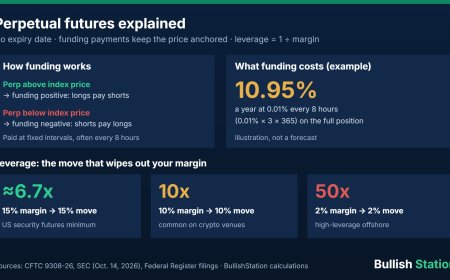
The decision matters because it moves one of crypto's signature products onto Wall Street's core asset. Perpetual futures, contracts with no expiry date that track a price through periodic funding payments, have until now been available on single US stocks only through offshore venues, out of reach for US customers.
"Today, perpetual futures contracts on individual equity securities (the 'Equity Perps') can begin trading for the first time on CFTC-registered exchanges," Chairman Michael Selig said in a statement released with Release 9319-26. He framed the move as bringing activity home, so that American traders are not "forced to turn to offshore, and often unregulated, venues."
How the contracts got through
The legal route is narrow and old. The CFTC classifies the contracts as security futures products under the Commodity Futures Modernization Act of 2000, which means both the CFTC and the Securities and Exchange Commission oversee them. Only designated contract markets that are also notice-registered with the SEC as securities exchanges can list them.
Selig tied the step to the agencies' March 2026 memorandum of understanding, and borrowed a phrase from SEC Chairman Paul Atkins, who described security futures as stuck in a regulatory "no man's land." The statement adds that "the CFTC and SEC have turned the page on that era."
What the statement does not say is just as telling. It names no exchange, no stock and no launch date, and it contains nothing on margin or leverage. Four filings are on the record, according to a SIFMA comment letter dated November 2: Bitnomial, Coinbase Derivatives, KalshiEX and Nadex. Our earlier report on the Form 1-N registrations lists the five exchanges that applied in September.
The timing follows the rulebook. Regulation 40.3 gives the Commission 45 days to review a new product before it is deemed approved. By BullishStation's count, filings made on September 18 reach that 45th day on November 2, which is exactly when the window closed and why trading could start on November 3.
Wall Street goes to court
Resistance arrived within hours. Cboe Global Markets said on November 3 that it has joined Citadel Securities and the Healthy Markets Association, under the banner of a "Capital Markets Alliance," in a lawsuit seeking to block the approvals. "This issue, however, is about investor protection for securities trading and the rule of law," Cboe Chief Executive Craig Donohue said in a statement.
SIFMA, the main securities-industry lobby, had already asked the SEC a day earlier to abrogate the exchange rule changes and force a full refiling, warning that "there are many unanswered questions" about the product. A CFTC spokesperson replied to the lawsuit that markets "should be governed by law, not litigation campaigns intended to block innovation," according to press reports.
The fight is not new. CME Group has challenged the CFTC's May 29 approval of the first US bitcoin perpetual, KalshiEX's BTCPERP, in federal court in Washington, arguing that perpetuals are swaps rather than futures. Cross-motions in that case are due on November 20.
For crypto markets, the stakes are about where leverage lives. Perpetuals on stocks are already offered by offshore crypto platforms that US customers cannot use, and a regulated US version could pull volume, collateral and fee income onshore. Our guide to perpetual futures explains how funding rates keep their price near the underlying stock.
History is not kind to single-stock futures in the US. OneChicago, the last dedicated exchange, closed in 2020 after almost two decades of thin volume, and the product only returned when CME launched single-stock futures this July. The difference now is the perpetual format, which crypto traders already know, and a market that is also moving toward tokenized stocks traded around the clock.
Two dates will shape what comes next: November 20, when cross-motions are due in CME's case against the CFTC, and the first exchange notices naming which stocks list and when. The broader CFTC crypto rulebook keeps evolving alongside.
Related: Cboe can list options on multi-crypto ETFs · What are Bitcoin ETFs?
Sources: CFTC, Statement on Equity Perpetual Futures and Release 9319-26 (Nov. 3, 2026); CFTC/SEC MOU, Release 9192-26 (Mar. 11, 2026); SIFMA letter (Nov. 2, 2026); Cboe statement (Nov. 3, 2026).
This article is for information only and is not investment advice. Perpetual futures are leveraged products and can lead to losses larger than the initial margin.
What's Your Reaction?
 Like
0
 Dislike
0
 Love
0
 Funny
0
 Wow
0
 Sad
0
 Angry
0














Comments (0)