

US Factory Index Jumps to 55.5 as Job Openings Climb to 7.5 Million, Keeping Pressure on a Divided Fed
US manufacturing expanded faster in October and job openings rose to 7.5 million in September, keeping pressure on a Federal Reserve that split 10-2 in October.


Published November 4, 2026 (ISM report of November 2, BLS JOLTS report of November 3). Information only, not investment advice.
Quick take
- The ISM manufacturing index rose to 55.5 in October, its 10th straight month of expansion.
- Its prices index stayed at 75.2, while US job openings rose to 7.5 million in September.
- Both point to an economy that gives the Fed little reason to ease before December 9.
US factory activity accelerated in October, with the Institute for Supply Management's manufacturing index rising one point to 55.5, and a day later the Labor Department reported 7.5 million job openings for September.
Taken together, the two reports matter because they land between a split Federal Reserve meeting and Friday's jobs report. On October 28 the Fed held its target range at 3.75% to 4.00% by a 10–2 vote, with Lisa Cook and Beth Hammack preferring another quarter-point hike. Strong demand and sticky input costs strengthen the case of those two dissenters.
"The Manufacturing PMI registered 55.5 percent in October, 1 percentage point above the September figure of 54.5 percent," Susan Spence, chair of ISM's Manufacturing Business Survey Committee, said in the October report. A reading above 50 signals expansion.
Prices still running hot inside factories
The detail is less comfortable for the Fed than the headline. Production climbed to 59.0 from 56.7 and new orders edged up to 55.5. Inventories moved back into expansion at 51.4. Employment, at 52.4, slipped 0.3 point but kept growing.
The prices index cooled to 75.2 from 77.9, yet "remained in expansion," Spence said. Respondents cited tariffs, steel and aluminum, and petroleum-based products tied to the Middle East conflict. By BullishStation's count, prices are running almost 20 points above the headline index, a gap that shows cost pressure is spreading faster than activity itself.
That matters for consumer prices with a lag. Factory input costs tend to show up first in producer prices, which jumped 1.3% in September, as our PPI coverage showed, and later in the consumer basket tracked by our CPI tracker.
The labor market is not cracking either. "The number of job openings was little changed at 7.5 million in September," the Bureau of Labor Statistics said in its JOLTS release. August was revised up by 111,000 to 7.2 million, and quits rose to 3.4 million, up 375,000 from a year earlier. By BullishStation's count, quits rose by 321,000 in a single month, to 3.37 million, a jump of about 10.5% that suggests workers still feel confident enough to change jobs. Layoffs held at 1.6 million.
Why crypto traders watch factory surveys
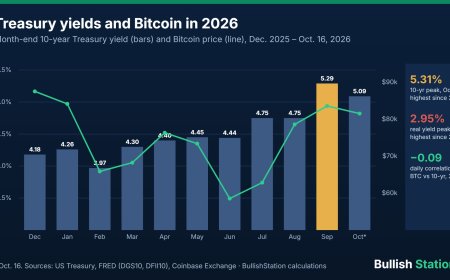
The chain from a factory survey to Bitcoin runs through rates. Firm growth and rising input costs keep the odds of a December hike alive, which supports Treasury yields. The 10-year yield closed at 4.95% on November 3, up from 4.91% the day before, according to Treasury yield curve data, and the 2-year stood at 4.61%.
Higher yields raise the return on cash and bonds and tend to weigh on assets with no yield, from growth stocks to Bitcoin, as our guide to Treasury yields and crypto explains. Bitcoin traded at about $78,360 on November 4 at 09:50 UTC, according to CoinGecko, roughly 3% below the $80,750 it fetched as the Fed's October statement came out.
History offers a caution. The last time the Fed kept tightening into strong data, in 2022, crypto fell further than equities as liquidity drained. This time the Fed raised rates as recently as September 16, two officials already want more, and markets will look for confirmation in the next prints rather than in one survey.
The next test comes on Friday, November 6, with the October employment report, followed by the October CPI on November 10. The Fed's next decision is due on December 9, a meeting our Fed decisions tracker will log.
Latest: US adds 165,000 jobs in October as Bitcoin ETFs lose $1.28 billion in a week
Related: How Fed interest rates affect Bitcoin · US consumer sentiment holds near record lows
Sources: ISM, Manufacturing PMI Report, October 2026 (Nov. 2, 2026); BLS, Job Openings and Labor Turnover, September 2026 (USDL-26-1630, Nov. 3, 2026); Federal Reserve, FOMC statement (Oct. 28, 2026); US Treasury daily par yield curve (Nov. 3, 2026); CoinGecko (Nov. 4, 2026).
This article is for information only and is not investment advice. Economic data are subject to revision.
What's Your Reaction?
 Like
0
 Dislike
0
 Love
0
 Funny
0
 Wow
0
 Sad
0
 Angry
0
















Comments (0)