

Australia's Central Bank Hikes to 4.85%, Its Highest Since 2008, as Three of Nine Board Members Dissent
The Reserve Bank of Australia raised its cash rate to 4.85% on November 3, 2026, its fifth hike this year, in a 6-3 vote as it pushed back its inflation outlook to late 2027.


Published November 4, 2026 (Reserve Bank of Australia decision of November 3). Information only, not investment advice.
Quick take
- The RBA raised its cash rate by 25 basis points to 4.85%, the highest level since late 2008.
- It was the fifth hike of 2026, but three of the nine board members voted to hold.
- The RBA now sees inflation staying above its 2–3% target until late 2027.
The Reserve Bank of Australia raised its cash rate target by a quarter point to 4.85% on November 3, its fifth increase this year, in a split six-to-three vote driven by a sharply higher inflation outlook.
The move puts Australia's policy rate above the 4.75% peak of 2010–2011 and at its highest level since late 2008, according to the RBA's own cash rate history. It also widens the gap with the Federal Reserve, whose target range tops out at 4.00%.
"Inflation remains elevated and recent data indicate that it is broadly based," the Monetary Policy Board said in its decision statement. Inflation is now "not expected to reach the top of the 2–3 per cent target range until late 2027, around three quarters later than previously forecast."
Oil, AI spending and a tighter economy
The board pointed to two very different forces. The first is energy. Higher fuel and commodity prices tied to the conflict in the Middle East are feeding into the prices of other goods and services, the statement said.
The second is more unusual for a central bank statement. "AI-related investment is driving rapid growth in prices for technology-related goods," the board wrote, adding that data-centre investment is also propping up business spending. Inflation worries are not limited to Australia, as our look at rising US inflation expectations showed.
That said, the decision was far from unanimous. "Six members voted to increase the cash rate target by 25 basis points to 4.85 per cent; three members voted to leave the cash rate target unchanged at 4.60 per cent," the statement said. The minority's caution has a clear basis: the RBA itself notes that the economy is slowing, housing prices have "fallen significantly" and unemployment has risen.
The pace of tightening is striking. By BullishStation's count from the RBA's table, the cash rate has climbed 125 basis points since January, from 3.60% to 4.85%, through hikes in February, March, May, September and November. That reverses all three cuts made in 2025 and more.
Why a rate hike in Sydney matters for Bitcoin
Australia is not a driver of global crypto prices on its own. Its decision matters as a signal. When a major central bank revises inflation higher and keeps hiking, it strengthens the case that rates elsewhere will stay high for longer.
The chain is familiar to crypto traders. Stickier inflation lowers the odds of rate cuts, which keeps bond yields elevated. Higher yields raise the return on cash and Treasury bills, which reduces the appeal of assets with no yield, such as Bitcoin, and has tended to slow inflows into spot ETFs. Our guide to how interest rates affect Bitcoin explains the mechanics.
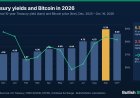
For now, the market reaction has been muted. Bitcoin traded near $78,370, or about A$111,830, on the morning of November 4, according to CoinGecko, up roughly 1.4% in Australian dollar terms over 24 hours. In the US, the 10-year Treasury yield stood at 4.95% on November 3, close to the levels tracked in our Treasury yields guide.
History offers a guide to how unusual this is. Australia's last tightening cycle ended at 4.35% in November 2023, and the one before that peaked at 4.75% in November 2010. To find a higher cash rate, you have to go back to the weeks after the collapse of Lehman Brothers, when the RBA was cutting from 7.25% toward 3%.
The Fed, by contrast, held its range at 3.75%–4.00% on October 28, with two officials preferring a hike, as our Fed decisions tracker records. The split votes on both sides of the Pacific show policymakers are divided on how much more tightening is needed.
The next tests come soon. The Bank of England announces its decision on Thursday, November 5, and US consumer prices for October follow on Tuesday, November 10, a release our CPI tracker will cover.
Latest: Bank of England raises rates to 4%, its first hike since 2023 (Nov. 5, 2026)
Latest: China's central bank adds 26 tonnes of gold in October as prices slide
Related: US CPI hits 3.7% in September · The US dollar index and Bitcoin
Sources: Reserve Bank of Australia, Statement by the Monetary Policy Board: Monetary Policy Decision (Media Release 2026-30, Nov. 3, 2026); RBA, Cash Rate Target history; US Treasury daily yield curve (Nov. 3, 2026); CoinGecko prices (Nov. 4, 2026).
This article is for information only and is not investment advice. Crypto assets are volatile and you can lose money.
What's Your Reaction?
 Like
0
 Dislike
0
 Love
0
 Funny
0
 Wow
0
 Sad
0
 Angry
0










Comments (0)